Truck Bao brand-new upgrade intelligent avoidance restricted area height limit width limit

[Original Truck House] After the opening of the Spring Festival in 2018, various new regulations and policies of the transportation department have been frequently spread. For those who listen to the wind and rain, they are afraid of what they missed, but it also shows the importance of travel in the eyes of Chinese people.

Truck Bao brand-new upgrade intelligent avoidance restricted area height limit width limit

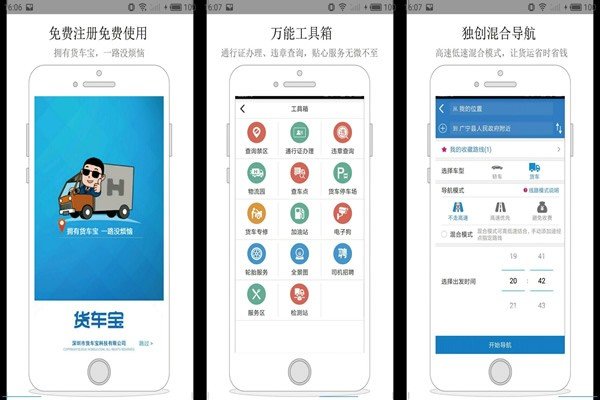
Navigation, as an indispensable tool for travel, meets people’s daily travel needs. At the same time, based on user habits and industry characteristics, in view of the increasing requirements of the particularity and functions of truck navigation, the truck treasure was officially updated in the spring of 2018, and the version was upgraded to(1.2.0.0.2).

Compared with the last version, the interface has been re-optimized, the operation instructions are simple and clear, and the visual effect is more beautiful.

Truck Bao brand-new upgrade intelligent avoidance restricted area height limit width limit

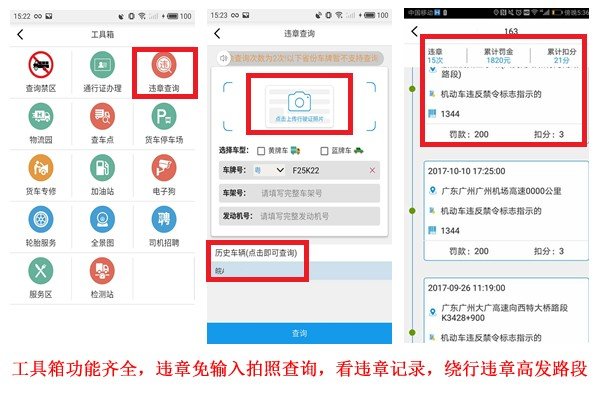
This version of the update has been fully optimized in function to simplify the user’s operation steps. Function updates mainly include the following four points:

Step 1 query the restricted area

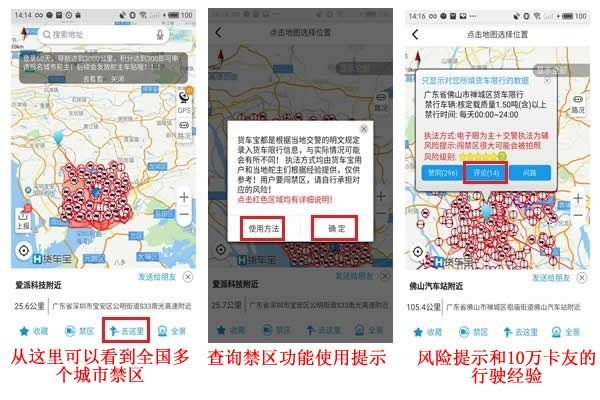
There are not many truck navigation that can query the restricted area in the market, and other map navigation software that can query the restricted area can’t be as accurate and comprehensive as truck navigation.

Truck Bao brand-new upgrade intelligent avoidance restricted area height limit width limit

Accuracy is because truck treasure is not a pure navigation technology company, but has 10,000+city helmsman and 100,000+loyal old truck drivers who are deeply involved in perfecting it, which belongs to the truck-specific navigation made by truck drivers themselves!

Truck Bao brand-new upgrade intelligent avoidance restricted area height limit width limit

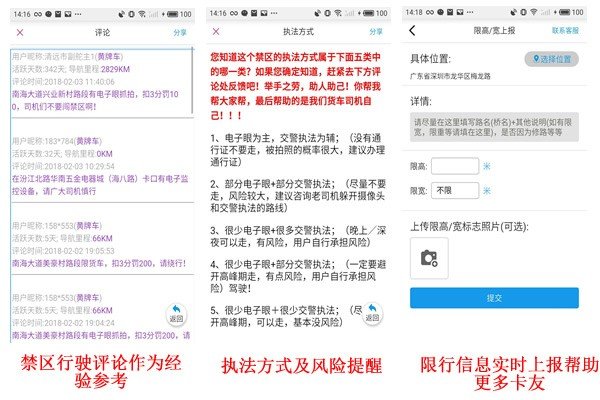
According to the different time limit and law enforcement methods, the truck treasure will provide the corresponding risks of the restricted section, ranging from five stars (high risk) to one star (low risk), and can drive selectively according to the corresponding risk tips; Card friends passing through the restricted area can also report the latest situation of the restricted area through the navigation of the truck treasure, which will benefit the card friends behind.

2. Intelligent navigation

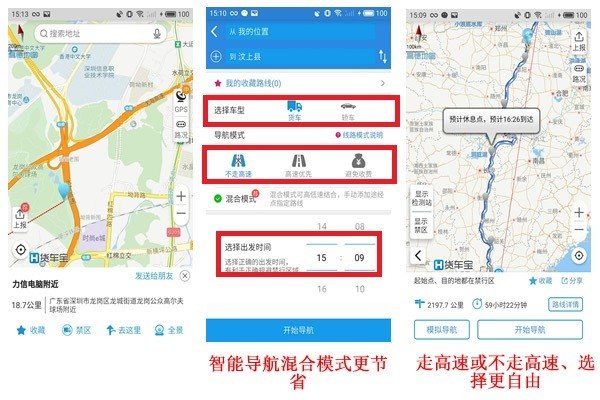
The new version of the navigation mode has been intelligently upgraded. It is recommended that card friends use the mixed mode of truck navigation, because navigation in this mode is more humanized, and you can set a route point for a certain section of the road, whether you take the high-speed or not, which can help you save a lot of costs such as high-speed fees, tolls and oil fees.

Truck Bao brand-new upgrade intelligent avoidance restricted area height limit width limit

In order to maximize the function of the restricted navigation area, it is necessary to choose the correct departure time when choosing the starting point and ending point of the mixed navigation mode, which is conducive to avoiding the restricted area more accurately.

3. Illegal inquiry

The illegal inquiry of truck treasure navigation is specially aimed at, which has the characteristics of fast inquiry speed, complete information, and direct inquiry by taking photos or uploading driving license photos without input, and the operation is simple and fast;

Truck Bao brand-new upgrade intelligent avoidance restricted area height limit width limit

The most important thing is that the violation records inquired by every truck driver will be saved, and then the truck treasure will be displayed in the comments after being processed by big data, which can be seen by more than 1 million truck drivers. In the future, the function of high incidence of truck violations will be introduced to warn truck drivers and users not to wear high-risk restricted areas indiscriminately, effectively reducing the fines for violations.

4. Pass processing

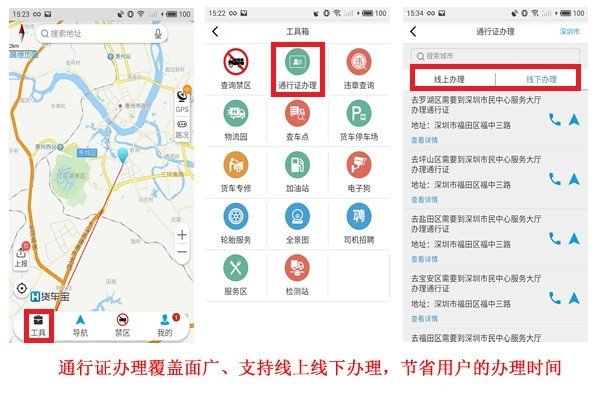
The previous version only supported some cities to apply for passes. This version is updated to increase the number of passes that all major cities in the country can apply for;

Truck Bao brand-new upgrade intelligent avoidance restricted area height limit width limit

The handling of the navigation pass for trucks greatly shortens the processing time for users. For major cities that need to handle the pass, users can choose to handle it online or offline, which is convenient for users to find the difficulty of handling the pass in strange cities.

The truck treasure navigation can also automatically broadcast electronic eyes, safety reminders, road condition reminders, voice broadcasts of restricted areas and other functions, freeing hands, and at the same time, preventing trucks from detouring and drivers from paying tickets.

Based on data updating and function optimization, the truck treasure navigation APP has been intensively cultivated, keeping up with the needs of users and constantly innovating and upgrading. (Text/Guan Guanqiang)

The first exposure notice of "Crazy Phone" 12.29 Mary Huo Siyan angered the broken bottle.

1905 movie network news Due to Miao’s director, Li Xiao, Wang Si and Huan Wang’s screenwriter, and Zhang Yibai’s producer, the film today exposed the "mobile phone is a knife" version, which is scheduled to be released nationwide on December 29th.

With the release of the first preview, the cast of the film was officially revealed. The "mobile phone" team composed of three male hosts, David, Qiao Shan and Tian Yu, and the "crazy ring" team composed of four female hosts, Mary, Huo Siyan, Lele Dai and Ming Xi, are about to start a desperate fight, and when the bell of the truth finally rings, who can get away from this "death game"?

The gold medal master with the ace IP "Perfect Stranger" China version is definitely worth looking forward to.

Yu Miao, the director, and Li Xiao, the screenwriter, have contributed many high-quality film and television dramas, such as "The Gentleman" and "The Little Husband" to the public. In 2016, the film they collaborated with won 650 million box office and became the biggest dark horse of the year. The vivid portrayal of characters, meticulous expression of emotions and sharp insight into life have always been the distinctive signs of their works.

Their new movie "Cell Phone Ringing" is adapted from Douban’s highest score comedy "Perfect Stranger" in 2016. The Korean version of "Perfect Stranger" topped the weekend box office in its first week of release, with an audience rating of 9.25 (out of 10), which shows its charm.

However, the original script is wonderful, but how to interpret the global topic of mobile phone from the perspective of China audience is the key to the success of the film. The creative team of "Crazy Cell Phone" was selected by the original Italian films layer by layer, and finally confirmed after strict evaluation.

After being authorized in 2016, China’s creative team devoted themselves to polishing the script for two years. On the basis of keeping the rules of the game and the high-energy plot of the whole process, they added more contradictory and localized characters in Chinese context, which not only continued the film quality, but also touched the essence of the relationship between people and mobile phones more deeply. What unique thoughts will the China version of Perfect Stranger bring, and what fresh vitality will the main creators inject into the film will become the most anticipated point of the film "Cell Phone Ringing".

Compared with the noisy scenes of many movies in the past, this year’s New Year’s Eve movie is more stable, and "Crazy Phone" is undoubtedly one of the most competitive movies in this movie. Looking back at the entire China film market in 2018, it is not difficult to find that most of the high-quality films that are applauded and hit the box office are concerned with realistic themes and have a great degree of topic discussion. Simple entertainment films can no longer meet the audience’s ever-increasing aesthetic needs. As Mary said in the trailer: "I used to think that the mobile phone could be an axe to help me overcome difficulties, but now it has become a knife."

Starting from the current hot topic "mobile phone", "Crazy Phone" deeply digs into the human weakness behind the real problems, which has a strong topic attribute in itself. The phenomenon that the Korean version of "Perfect Stranger" which is being shown is hotly debated by the whole people and sold well at the box office also makes people look forward to "Crazy Phone" more. Compared with other films in the same period, the novel "Crazy Phone" with unique and profound theme, solid script foundation and high-quality creative team will surely stand out, injecting a shot in the arm for the China film market at the end of the year and detonating the whole Lunar New Year file.


The "mobile phone is a knife" version of the trailer, the mobile phone becomes a crisis meal, and the "death game" officially opens.

The core settings and conflicts of the original Perfect Stranger all come from an impromptu game. The rules of the game are that everyone should put their mobile phones on the table, and text messages, WeChat and incoming calls should be exposed in front of everyone. "Crazy Phone" also follows this game setting. When the protagonists speak the rules of the game with a relaxed look, they don’t know what they are about to face.

Everyone doesn’t want to expose the most secret story in the mobile phone until the game puts them on the judgment table of humanity. During the game, the mobile phone is a sharp blade hanging over everyone’s head. Every text message and every phone call may make the sharp blade fall, and love, friendship, career and family will all be buried with this game. Spying into human nature, piercing the truth, the mobile phone became a crisis, the dinner became a war situation, and the "death game" officially opened.

The relaxed and pleasant atmosphere at the beginning of the trailer of "Mobile phone is a knife" came to an abrupt end after the game started, followed by the escalating conflict. From Qiao Shan’s and Tian Yu’s intertwined drinking and laughing, to David’s and Ming Xi’s mutual temptation, to Mary’s and Huo Siyan’s angry broken wine bottles, full of drama tension, delicate performances and sharp lines with background music, the fierce confrontation of human nature behind the game is infinitely magnified, and the great destruction brought by mobile phones has never been so real and concrete in front of the audience, which makes us have to rethink whether the mobile phone is kidnapping you. Will the mobile phone become the sharp knife that will eventually be inserted into you?


The film "Cell Phone Ringing" will be released nationwide on December 29th, due to director Miao, screenwriter Li Xiao, Wang Si and Huan Wang, producer Zhang Yibai, and produced by Xinli Film, Shibuya Film, Cat’s Eye Film and Moby Dick Film.

"The most beautiful worker" in the general secretary’s heart

Twenty days ago, on the bank of Yongding River in Beijing, General Secretary of the Supreme Leader shoveled soil to make pits, raised soil and cofferdams, lifted water and watered them, and planted many seedlings.

This scene overlaps with his "micro-lens" of carrying a shovel to do farm work in Liangjiahe, northern Shaanxi decades ago and participating in sand control work in Gulang, Gansu a few years ago, which reflects the consistent nature of the people’s leaders.

Coming from the working people, General Secretary of the Supreme Leader advocates labor and respects laborers. He said that model workers are outstanding representatives of the working people and the most beautiful workers.

In the spring of 2013, in an ordinary conference room of the All-China Federation of Trade Unions, the General Secretary sat down with 65 representatives of model workers from different industries and different periods from all over the country to have a heart-to-heart talk. He said, "Seeing everyone, I am in awe of the model workers, and the feelings of respecting knowledge and labor arise."

On that day, Liang Jun, who was rated as a national model worker at the age of 21, shared her dream of building Beidacang when she was young. The general secretary responded affectionately: "Your deeds are known to people of our age. The first female tractor driver in China, you are amazing. "

At this symposium, the general secretary expounded his thoughts on "nothing is difficult in the world". He pointed out: everything in the world is hard. The brighter the future, the more we need to work hard.

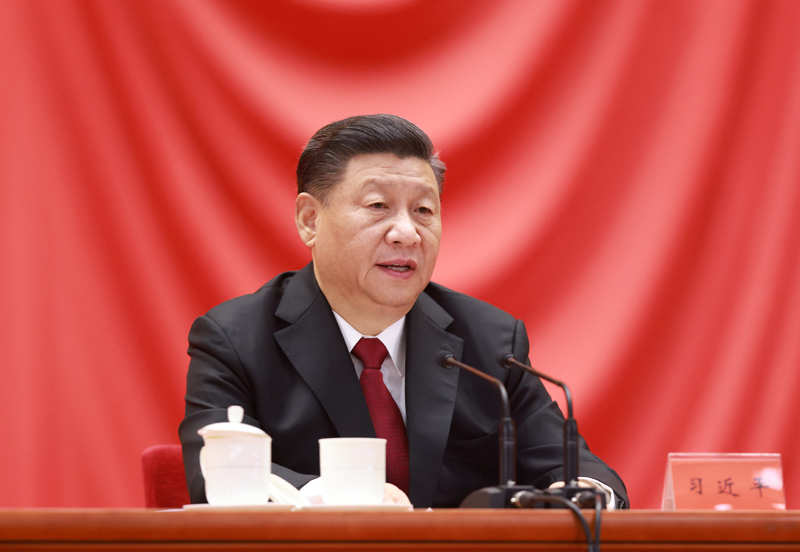
On November 24, 2020, General Secretary of the Supreme Leader attended the National Commendation Conference for Model Workers and Advanced Workers and delivered an important speech.

On November 24, 2020, General Secretary of the Supreme Leader attended the National Commendation Conference for Model Workers and Advanced Workers and delivered an important speech.

Gansu Gulang Babusha Forest Farm also witnessed the general secretary’s respect for workers.

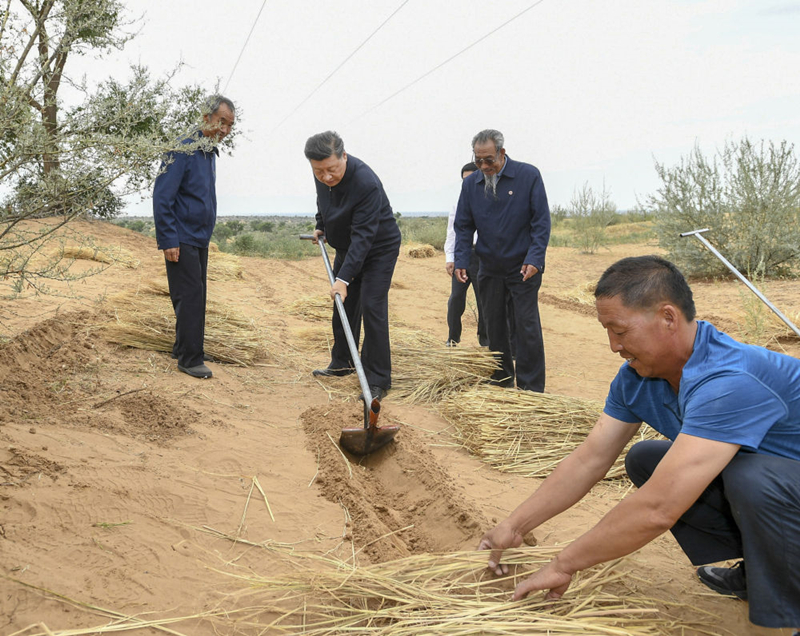
On August 21, 2019, the General Secretary of the Supreme Leader who came here for an inspection leaned over and turned over the sand with the staff of the forest farm, and soon opened a straight ditch more than two meters long in the sand.

Guo Wangang, a representative of the afforestation people and a national model worker, was also at the scene. He told the General Secretary that it is with this manual labor mode that "one tree, one handful of grass, and sand can be pressed against the wind", and three generations have accumulated more than 200,000 mu of sand control and afforestation.

"It is not easy for your generations to stick to it for decades." The general secretary said with emotion, "I want to learn from you." A few months later, when the supreme leader delivered a New Year message, a photo of him with the staff of the forest farm was placed on the bookshelf behind him.

Heroes come from the people, and models come from the masses.

Meng Tai, Defender of Blast Furnace, Wang Jinxi, Iron Man, Deng Jiaxian, Outstanding Representative of Intellectuals, Shi Chuanxiang, Blue-collar Expert Kong Xiangrui, Gold Medal Worker Dou Tiecheng, Iron Man Wang Qimin in New Era, Lei Feng Xu Hu in New Era and Knowledge Worker. …

This is a long list of names blurted out by the general secretary at a forum.

They, "do one line, love one line, specialize in one line and be good at one line." Their stories explain what a model worker is; Their struggle is the spirit of model workers.

On August 21, 2019, the General Secretary of the Supreme Leader was in Babusha Forest Farm, Gulang County, Wuwei City, Gansu Province, and turned over the sand and ditched with the forest farm staff.

On August 21, 2019, the General Secretary of the Supreme Leader was in Babusha Forest Farm, Gulang County, Wuwei City, Gansu Province, and turned over the sand and ditched with the forest farm staff.

"Labor is the source of all happiness." General Secretary of the Supreme Leader once said that the model workers’ spirit of "loving their posts and being dedicated, striving for first-class, working hard, being brave in innovation, being indifferent to fame and fortune and being willing to contribute" is a vivid embodiment of the great spirit of the times.

On the last day of April, 2018, the undergraduate class of model workers in China Institute of Labor Relations received a special reply from the "Supreme Leader". The general secretary wrote in the letter: "I am very happy to receive your letter." You have made outstanding contributions to the development of the cause of the party and the country, and you have been rated as a model worker. Now you are studying for further study. This is a praise for your hard work and selfless dedication, and it is also the concern of the party and the country for workers. "

Huang Baomei, a model worker who came out of the textile workshop, worked hard all his life to realize the dream of "the whole country is well dressed". A few years ago, the general secretary had a cordial conversation with her during an inspection tour in Shanghai, praising her as a "witness, participant and devotee" of national development.

Wang Lanhua, a model worker who grew up with the Republic, is called "Living Lei Feng" in the community. She said that when she is tired and hard, she often thinks of what the general secretary said, "socialism is done."

In today’s China, dreams come true one after another, which cannot be separated from every worker’s dream-chasing running.

From scientific and technological miracles such as "Shenzhou" flying and "Eye of the Sky" sounding, to major projects such as the Qinghai-Tibet Railway and the Hong Kong-Zhuhai-Macao Bridge, and to tough battles such as precision poverty alleviation and pollution prevention & HELIP; … All aspects of economic and social development have left the struggle footprints of model workers.

At an altitude of more than 40 meters, Zhu Shijie, a bridge crane driver, can always complete container loading and unloading quickly and accurately in the face of complex and changeable weather and ship types with different specifications.

On March 29th, 2020, on a rainy spring day, the General Secretary visited Chuanshan Port Area of Zhoushan Port in Ningbo, Zhejiang Province, and Zhu Shijie was also on the scene. The accompanying inspector told the General Secretary: "At the end of 2006, when you personally started the lifting button of the 7 millionth TEU on this dock, he was the operator who lifted the container."

When he met Zhu Shijie, the general secretary told him to play a good role as a model worker and bring out more model workers.

The general secretary hopes that the model workers will inspire more people with their own energy, enterprising spirit and hard work, and encourage the broad masses of working people to strive to be strugglers in the new era.

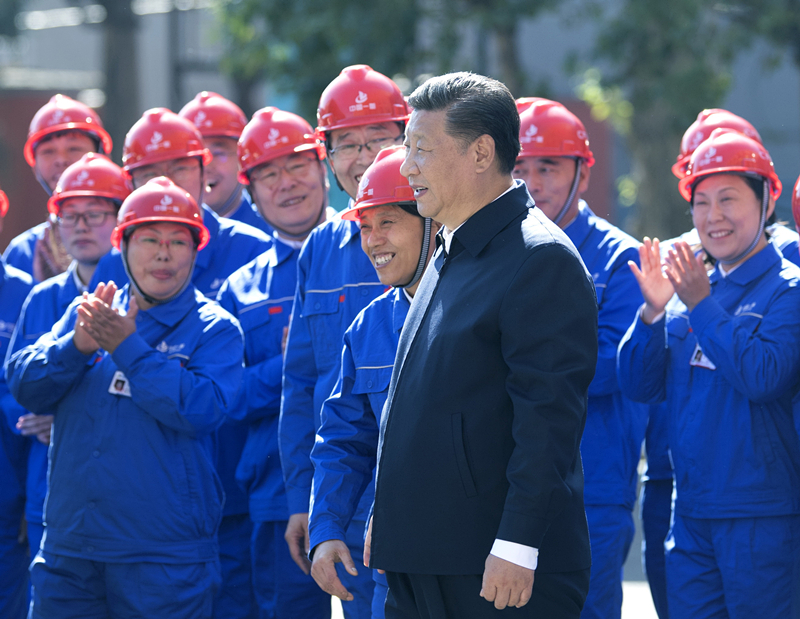
On September 26, 2018, in China Yizhong Group, General Secretary of the Supreme Leader walked among the workers and had a cordial exchange with them.

On September 26, 2018, in China Yizhong Group, General Secretary of the Supreme Leader walked among the workers and had a cordial exchange with them.

He praised "everyone has made contributions, everyone is great" and "model workers are outstanding representatives of the working people and the most beautiful workers".

He is far-sighted, "providing all-round support for model workers to better display their talents and show their spiritual character, so that their labor skills, innovative methods and management experience can be widely spread."

He personally, "vigorously publicize the advanced deeds of model workers in the whole society and call on the whole society to learn from them and pay tribute to them."

He earnestly enjoined, "In a country with a population of 1.4 billion, everyone can make a contribution and gather into an overwhelming force. If everyone does one thing and does a good job, the cause of the party and the country can move forward."

… … … …

In the vivid and wonderful story of the new era, every worker is the protagonist.

Violation of discipline and discipline, putting on "invisibility cloak", digging deep into the invisible variation of four winds

  During the Dragon Boat Festival, the discipline inspection and supervision organs at all levels adhered to the strict main tone, being strict in management, daring to be strict in management, and being strict in management, strengthening supervision and inspection, conducting unannounced visits, guarding important nodes, strengthening notification and exposure, and taking effective measures to prevent rebound, invisible variation, fatigue and war-weariness, and constantly consolidating and deepening the achievements of work style construction.

  The data shows that as of 18: 00 on June 13th, the website of the State Supervision Commission of the Central Commission for Discipline Inspection had reported and exposed 127 typical cases of violating the spirit of the eight central regulations before the Dragon Boat Festival, with hedonism and extravagant style accounting for the most.

  Correcting the "four winds" has a long way to go, and it will rebound if it is slightly relaxed

  Judging from the types of problems reported, three types of problems, namely, illegal receipt and delivery of rare specialty products and gifts, illegal eating and drinking, illegal payment of subsidies or welfare, accounted for 29.9%, 25.1% and 10.2% of the total number of hedonism and extravagance respectively.

  Combing the cases, it is found that these typical problems appear repeatedly and their forms are constantly changing. For example, some do not directly accept cash-filled red envelopes and evolve into WeChat transfers; Some are equipped with official vehicles in a way of splitting car prices; Some take advantage of the theme party day activities to travel with public funds.

  In the bulletin, all localities will strictly deal with those who are incorrigible and have a bad nature according to the rules and regulations. Zhang Xiaolin, former deputy director of Zhangjiachuan County Bureau of Culture, Radio, Film and Television and former director of the Tourism Bureau in Tianshui City, Gansu Province, was severely punished by the party in 2015 for violating the law. In 2016, he was punished by staying in the party for one year. In 2017, he was dismissed from his post and reduced to deputy director. During the period of punishment, Zhang Xiaolin accepted banquets and entertainment activities arranged by management clients for many times, and received gifts and gifts for four times. In July last year, Zhang Xiaolin was expelled from the Party and dismissed from government affairs, and was reduced to a second-class clerk.

  There are also some party member cadres who are lucky and paralyzed. For example, Gan Lin, vice chairman of the Political Consultative Conference in Jing ‘an County, Jiangxi Province, and the second-class researcher, and other people discussed with the invited staff of a pictorial newspaper about the compilation of the album and booked a working dinner. After a group of four people from Pictorial Newspaper returned because of something, Gan Lin continued to lead the relevant people in the county to dine and drink illegally, and the expenses were used to sign the bill in the name of the county CPPCC. In February this year, Gan Lin was punished by government warning.

  Some party member cadres, who should set an example for their relatives, first touched the red line of discipline. For example, Jin Gaobo, the former secretary, executive director and manager of the Party branch of Shanxi Coking Coal Yuncheng Salt Chemical Machinery Company, reimbursed the train tickets, accommodation fees and fuel costs that should be borne by his relatives and others for 3400 yuan. Feng Zanxiang, a third-level researcher in Yueyanglou District, Yueyang City, Hunan Province, designated the restaurant operated by his brother as a reception dining place during his tenure as the executive deputy commander of Linyue Expressway and Menghua Railway Project Headquarters, and arranged official receptions for many times in violation of regulations. Feng Zanxiang was punished by warnings within the party.

  Style construction is always on the road. Discipline inspection and supervision organs adhere to the iron fist discipline, dare to show their swords, deepen the use of party discipline and government affairs, organizational treatment or organizational adjustment, and really hit the sore spot and achieve practical results, so that those who are lucky lose their illusions, those who pretend to sleep suddenly wake up, and bystanders are wary.

  Violation of discipline and discipline is covered with "invisibility cloak"

  The reporter noted that in the reported cases, it is more serious to cover the violations of discipline with "invisibility cloak" by fictional means, and the problem of invisible "four winds" is latent.

  Some eat, drink or receive food in violation of public funds by falsely reporting the purchase of ingredients in the canteen. Xinfeng County, Jiangxi Province, the Federation of Supply and Marketing Cooperatives reimbursed the reception expenses of 138,000 yuan by purchasing ingredients in the unit canteen without a reception letter, a reception approval form and a reception list. He also bought 2,516 yuan of drinks by falsely reporting the purchase of ingredients in the canteen for official reception. As the party secretary and director of the unit, Xiang Li took the main leadership responsibility for the above issues. In March this year, Xiang Li was severely punished by the Party.

  Some illegally give gifts from public funds in the name of business entertainment. In February this year, Fu Xianhui, member of the Standing Committee of Yuehu District Committee of Yingtan City, Jiangxi Province, and deputy head of the district government, proposed that he had served as the deputy director of the office of the Provincial People’s Social Security Department when he arranged for Gui Xitian, director of the District People’s Social Security Bureau, to give some local products to his old colleagues. Gui Xitian said that the above expenses were paid by the District People’s Social Security Bureau, and Fu Xianhui acquiesced. When the gift moved into the office building, it was discovered by the unannounced interview team on the spot. The two were punished by warnings within the party.

  Some illegally issue allowances and subsidies by signing false employment contracts and falsely reporting workload. Li Yanhong, vice captain of the coal mine safety inspection brigade in Xingshan District, hegang City, Heilongjiang Province, decided to falsely report the number of times of entering the well, and paid 7,325 yuan for 19 people in this unit in violation of regulations. In December last year, Li Yanhong was punished by government warning and the related expenses were ordered to be returned.

  These problems reflect that a small number of cadres in party member do not stop converging, do not perform their duties and do their duty, encourage bad habits, and have been dealt with seriously, with profound lessons.

  In-depth analysis to identify the crux and promote the source governance of system governance

  Generally speaking, the spread of "four winds" has been effectively curbed, but the "pathogen" has not been eradicated, and the rectification of "four winds" is still on the way. We must stick to the spirit of implementing the eight central regulations, adhere to the "three noes" and treat both the symptoms and the root causes.

  Taking the problem of illegal eating and drinking as an example, since the beginning of this year, the Supervision Committee of the Hunan Provincial Commission for Discipline Inspection has deployed centralized rectification actions for illegal eating and drinking in the province, announced the "Ten Prohibitions" disciplinary regulations, and targeted the rectification of illegal eating and drinking. The Supervisory Committee of the Provincial Commission for Discipline Inspection sorted out 100 typical clues of "four winds" and put them on the list for supervision, and all of them were completed.

  All localities and departments in Hunan Province acted quickly, insisting that the main responsibility and supervision responsibility resonate in the same frequency and exert their efforts in the same direction, and the "top leaders" took the lead in promoting the rectification work to achieve practical results. In the first five months, the province investigated and dealt with 150 cases of illegal eating and drinking, handled 295 people, and gave 189 disciplinary actions.

  Corruption and unhealthy tendencies are intertwined, and "four winds" has become a hotbed of corruption. Discipline inspection and supervision organs at all levels adhere to the promotion of punishing corruption and rectifying the "four winds" as a whole, dig deep into the discipline review work, and give priority to handling mental problems that violate the eight central regulations.

  The problem of work style is intractable and repetitive, and it should be solved not only by the organization, but also by the supervision of the masses, paying attention to giving play to the supervisory role of the masses. The Supervision Committee of the Hubei Provincial Commission for Discipline Inspection keeps a close eye on key nodes such as various holidays, strengthens the use of scientific and technological means, and uses the online "internet plus Smart Supervision" platforms such as websites, mobile phone clients and WeChat WeChat official account to rectify the invisible variation "four winds" problem by means of taking pictures of festivals, reporting with one click and comparing data. (Reporter Li Lingna Zhang Qibin)

Trump’s lowest-key daughter is married and the groom is a billionaire.

Original Bund Jun Bund TheBund

Although he is a billionaire heir.

The groom joined the Trump family without hesitation.

The Trumps and a couple.

A few days ago, Trump’s second daughter Tiffany married billionaire Michael Blos.

Trump’s two daughters, the eldest ivanka, are famous. They used to accompany their father to farmland. By contrast, Tiffany, 29, is keeping a low profile.

She is the only one of Trump’s adult children who has not been prosecuted, and was once said to be the most unpopular daughter of Trump.

The groom Michael Blos is Lebanese, four years younger than Tiffany. Although there is no father who has been president, there is a mine at home.

My father, Masad Blos, is a billionaire who owns two listed companies. All Nigerian industries are related to his family. Therefore, although Michael is only 25 years old, he is also the vice president of the group, worth over 100 million yuan.

Two families

This is an absolute strong alliance.

01

Trump’s manor

Elie Saab’s wedding dress

In-laws are Trump "fans"

The wedding was held at Haihu Manor in Palm Beach, Florida, USA. This manor with a history of nearly 100 years is known as the highest social circle in the United States. Trump bought it in 1985 for less than $8 million.

Haihu Manor covers an area of 80,000 square meters (20 times that of Dabei’s wedding venue), with lush palm trees and a unique view by the sea. During Trump’s administration, Chinese and American leaders met here, and the specifications were quite high.

It is said that Haihu Manor was chosen because Tiffany was born and spent her childhood here, which is of special significance, but it has no political significance.

Tiffany’s wedding dress chose Lebanese brand Elie Saab, which is not only one of the favorite high-definition brands of superstars and celebrities, but also from the country where the groom belongs, which is perfect.

Marla Maples, Tiffany’s mother and Trump’s second wife, is quite satisfied with this dress. "Elie Saab has created a miracle. “

Tiffany’s dress for receiving guests is much more low-key, and it is a white lace dress designed by Oscar Lopez.

As can be seen from past photos, Tiffany’s figure is still relatively plump. For the wedding, it’s hard to lose weight.

The whole person lost a big circle.

Although the identity of the guests was kept secret, it was revealed that the great-great granddaughter Gaia Matisse (mother is artist Sophie Matisse and father is artist Alain Jacquet) of artist Masti, celebrity Karen Shiboleth and Peter Brant Jr, son of supermodel Stephanie Seymour, attended the wedding.

As for the Trump family, it must be all out.

After the ceremony, Trump specially took a group photo with his five children: from left to right, the second son Eric, the eldest son Donald Jr., Tiffany, the youngest Barron and ivanka.

Even though they were told many times that their feelings were not in harmony, Melania and Trump danced to Frank Sinatra’s quite classic song Strangers in the Night in such a warm situation.

The two men were seen whispering while dancing, and Melania rarely smiled at her husband.

During the wedding rehearsal, Trump also took photos with his two wives. On the left is Tiffany’s mother, and on the right is Melania.

All three people looked happy, and Trump secretly gave a thumbs-up sign.

The bridesmaids are all wearing aquamarine skirts. Although ivanka, the eldest sister, is not a bridesmaid, I have to say that her long dress with Greek style looks the best in texture.

Plus, people are beautiful and smooth, which is really beautiful.

Husband Jared Kushner is just a pendant.

The sisters have a good relationship.

Before the wedding, ivanka also helped Tiffany adjust her wedding dress.

The groom Blos’s family also came.

Father Masad Blos wears gold-rimmed glasses and looks like a brother to the groom. He owns two major enterprises, Boulos Enterprises and SCOA Nigeria, and his business involves automobile, retail, energy, construction and so on.

It is said that Masad himself is an iron fan of Trump, and he is very happy to become in-laws with Trump.

02

Trump’s lowest-key child

Tiffany’s life is a typical American socialite.

I went to the famous University of Pennsylvania, fell in love with the son of a rich man of the same class, and wanted to be a star or KOL in my spare time.

When I was in high school, I broke into the entertainment circle, made a single, appeared on Oprah’s show, and walked through the show, but none of them aroused any splash.

When she was in college, ivanka helped her get into VOGUE as an intern. It is said that Anna Untul made a special trip to have lunch with Tiffany.

But compared with Trump’s other children, Tiffany is a special one.

Parents divorced early, and Tiffany was mainly brought up by her mother, and she did not participate in Trump’s great cause.

But if it is said that Trump does not like this daughter, it is a bit of a shadow.

When Tiffany was born,

Haihu Manor used to be Tiffany’s paradise.

When I was 5 years old, I held a birthday party called Titanic here.

Driving bumper cars with my parents.

Unfortunately, the following year, when her parents divorced, Tiffany moved to Los Angeles with her mother and attended an aristocratic school with an annual tuition fee of more than 200,000 RMB.

Although they don’t live with Trump, father and daughter often meet. Trump also took her on a date with his new girlfriend Melania (current wife).

After her father became president, although she didn’t have a formal position like her sister, she also made frequent public appearances. Low-key is a little low-key, maybe it’s people’s personality and hobbies, not marginal people.

03

Groom: I’m here to join this family.

No matter how low-key Tiffany is, as Trump’s children, everything has been stripped clean.

By contrast, Michael Blos’s information is not much.

Michael is of Lebanese and French descent and grew up in his hometown of Old Dulagus, Nigeria. I studied at Regent University in England, where I lived in a luxury apartment of 1.2 million euros. I went to London University as a graduate student and got a master’s degree in finance. After graduation, I worked in the family business.

In addition, the children of these rich people really love to break into the entertainment circle. Michael had a younger brother who played soy sauce in The Crown and Fantastic Animals, but he didn’t make a name for himself.

Michael Blos and his family.

It’s quite a coincidence that two people met.

Although Tiffany didn’t get ahead in the entertainment circle, she also made some friends in the circle. In the summer of 2018, she and lindsay lohan were on vacation in Mykonos Island, where they met Michael in the club.

Some people say that Lindsay is a matchmaker, but she denies it, saying that although I know both of them well, I didn’t pull strings.

After only a few months of love, on Thanksgiving Day in 18, American media reported that Tiffany introduced Michael to Trump.

In January of the following year, after Tiffany officially announced her love affair in ins, the relationship between them advanced by leaps and bounds.

Michael basically participated in all the activities of the Trump family.

This is not hard-you know, Michael is studying in England, and they have been in foreign love for a long time. This trapeze artist is still doing his best.

Just kidding, he and big bay "adopted by adoption" Nicola’s state is almost the same.

Michael is very sincere. The marriage proposal ring is 13 carats long and worth nearly 10 million RMB.

No matter whether the families of both sides need each other, at least two young people are sweet from beginning to end, and it is natural to get married.

As for what will happen in the future, who knows

Text, editor//siri110

Part of the information comes from Daily Mail, insider, new york Times, CNN, etc.

The picture comes from the network, please contact to delete the infringement.

The above content comes from "TheBund" (micro signal: the-bund).

Lawyers have been authorized to investigate and defend the copyright of articles.

Original title: "Trump’s lowest-key daughter gets married and the groom is a billionaire"

Read the original text

People’s Republic of China (PRC) labor contract law

????????????????Catalogue
????????Chapter I General Principles
  Chapter II Conclusion of Labor Contracts
  Chapter III Performance and Alteration of Labor Contracts
  Chapter IV Dissolution and Termination of Labor Contracts
  Chapter V Special Provisions
    Section 1 Collective Contract
    Section 2 Labor Dispatch
    Section 3 Part-time Employment
  Chapter VI Supervision and Inspection
  Chapter VII Legal Liability
????????Chapter VIII Supplementary Provisions

????????????????Chapter I General Principles
  Article 1 This Law is formulated in order to improve the labor contract system, clarify the rights and obligations of both parties to a labor contract, protect the legitimate rights and interests of workers, and build and develop harmonious and stable labor relations.
  Article 2 This Law is applicable to enterprises, individual economic organizations, private non-enterprise units and other organizations in People’s Republic of China (PRC) (hereinafter referred to as employing units) that establish labor relations with laborers and conclude, perform, modify, dissolve or terminate labor contracts.
  State organs, institutions, social organizations and laborers who have established labor relations with them shall conclude, perform, change, dissolve or terminate labor contracts in accordance with this Law.
  Article 3 The principles of legality, fairness, equality, voluntariness, consensus through consultation, honesty and credibility shall be followed in concluding a labor contract.
  The labor contract concluded according to law is binding, and the employer and the employee shall perform the obligations stipulated in the labor contract.
  Article 4 The employing unit shall establish and improve labor rules and regulations according to law, so as to ensure that laborers enjoy labor rights and perform labor obligations.
  When an employer formulates, modifies or decides on rules and regulations or major issues directly related to the vital interests of workers, such as labor remuneration, working hours, rest and vacation, labor safety and hygiene, insurance and welfare, employee training, labor discipline and labor quota management, it shall discuss with the workers’ congress or all employees, put forward plans and opinions, and negotiate with the trade union or employee representatives on an equal footing.
  In the process of implementing rules and regulations and major issues, if the trade union or employees think it inappropriate, they have the right to propose it to the employer and revise and improve it through consultation.
  The employing unit shall publicize the rules, regulations and major issues directly related to the vital interests of workers, or inform them.
  Article 5 The labor administrative department of the people’s government at or above the county level shall, together with representatives of trade unions and enterprises, establish and improve a tripartite mechanism for coordinating labor relations and jointly study and solve major issues related to labor relations.
  Article 6 Trade unions shall help and guide laborers to conclude and perform labor contracts with employers according to law, and establish a collective consultation mechanism with employers to safeguard the legitimate rights and interests of laborers.
????????????????Chapter II Conclusion of Labor Contracts
  Article 7 The employing unit shall establish labor relations with laborers from the date of employment. The employing unit shall establish a roster of employees for future reference.
  Article 8 When employing workers, the employing unit shall truthfully inform the workers of their work contents, working conditions, working place, occupational hazards, safe production conditions, labor remuneration and other information that the workers require to know; The employer has the right to know the basic information directly related to the labor contract, and the employee shall truthfully explain it.
  Article 9 The employing unit shall not detain the employee’s resident identity card and other certificates, and shall not require the employee to provide guarantee or collect property from the employee in other names.
  Article 10 To establish labor relations, a written labor contract shall be concluded.
  If a labor relationship has been established and a written labor contract has not been concluded at the same time, a written labor contract shall be concluded within one month from the date of employment.
  If the employer and the employee conclude a labor contract before employment, the labor relationship shall be established from the date of employment.
  Article 11 If the employer fails to conclude a written labor contract at the same time of employment, and the labor remuneration agreed with the employee is not clear, the labor remuneration of the newly recruited employee shall be implemented in accordance with the standards stipulated in the collective contract; If there is no collective contract or it is not stipulated in the collective contract, equal pay for equal work shall be implemented.
  Article 12 Labor contracts are divided into fixed-term labor contracts, non-fixed-term labor contracts and labor contracts with the completion of certain tasks as the term.
  Article 13 A fixed-term labor contract refers to a labor contract in which the employer and the employee agree on the termination time.
  The employer and the employee may conclude a fixed-term labor contract through consultation.
  Article 14 An open-ended labor contract refers to a labor contract in which the employer and the employee agree on an indefinite termination time.
  The employer and the employee may conclude an open-ended labor contract through consultation. Under any of the following circumstances, if an employee proposes or agrees to renew or conclude a labor contract, an open-ended labor contract shall be concluded in addition to the employee’s proposal to conclude a fixed-term labor contract:
  (1) The employee has worked in the employing unit continuously for ten years;
  (2) When the employing unit first implements the labor contract system or the state-owned enterprise is restructured and re-concludes the labor contract, the employee has worked continuously in the employing unit for ten years and is less than ten years away from the statutory retirement age;
  (3) Having successively concluded two fixed-term labor contracts, and the employee does not have the circumstances specified in Items 1 and 2 of Article 39 and Article 40 of this Law, and the labor contract is renewed.
????????If the employer fails to conclude a written labor contract with the employee within one year from the date of employment, it shall be deemed that the employer and the employee have concluded an open-ended labor contract.
  Article 15 A labor contract with the completion of a certain task as the term refers to a labor contract in which the employer and the employee agree that the completion of a certain job is the term of the contract.
  The employing unit and the laborer may conclude a labor contract with the completion of certain tasks as the term.
  Article 16 A labor contract shall come into effect after the employer and the employee reach an agreement through consultation and sign or seal the text of the labor contract.
  The text of the labor contract shall be held by the employer and the employee respectively.
  Article 17 A labor contract shall have the following clauses:
  (a) the name, domicile and legal representative or principal responsible person of the employing unit;
  (2) The name and address of the laborer and the number of the resident identity card or other valid identity documents;
  (3) The term of the labor contract;
  (4) Work content and work place;
  (five) working hours and rest and vacation;
  (6) Labor remuneration;
  (7) Social insurance;
  (eight) labor protection, working conditions and occupational hazard protection;
  (nine) other matters that should be included in the labor contract as stipulated by laws and regulations.
  In addition to the necessary clauses stipulated in the preceding paragraph, the employer and the employee may agree on probation, training, keeping secrets, supplementary insurance and welfare benefits.
  Article 18 If the labor contract is not clear about the standard agreement on labor remuneration and working conditions, which causes disputes, the employer and the employee may negotiate again; If negotiation fails, the provisions of the collective contract shall apply; If there is no collective contract or the collective contract does not stipulate labor remuneration, equal pay for equal work shall be implemented; If there is no collective contract or the collective contract does not stipulate working conditions and other standards, the relevant provisions of the state shall apply.
  Article 19 If the term of a labor contract is more than three months but less than one year, the probation period shall not exceed one month; If the term of the labor contract is more than one year but less than three years, the probation period shall not exceed two months; The probation period of a labor contract with a fixed term of more than three years or without a fixed term shall not exceed six months.
  The same employer and the same employee can only agree on a probation period.
  A probation period may not be agreed upon in a labor contract whose term is to complete certain tasks or whose term is less than three months.
  The probation period is included in the labor contract. If the labor contract only stipulates the probation period, the probation period is not established, and this period is the term of the labor contract.
  Article 20 The salary of a worker during the probation period shall not be lower than the lowest salary of the same position in the unit or 80% of the salary agreed in the labor contract, and shall not be lower than the minimum wage standard where the employer is located.
  Article 21 During the probation period, the employing unit shall not terminate the labor contract, except for the circumstances stipulated in Article 39 and Item 1 and Item 2 of Article 40 of this Law. If the employer terminates the labor contract during the probation period, it shall explain the reasons to the employee.
  Article 22 Where an employing unit provides special training fees for laborers and provides them with professional and technical training, it may conclude an agreement with the laborers to stipulate the service period.
  If the laborer violates the service period agreement, he shall pay liquidated damages to the employer in accordance with the agreement. The amount of liquidated damages shall not exceed the training expenses provided by the employer. The liquidated damages that the employer requires the workers to pay shall not exceed the training expenses that should be shared for the unfulfilled part of the service period.
  If the employer and the employee agree on the service period, it will not affect the improvement of the employee’s labor remuneration during the service period according to the normal wage adjustment mechanism.
  Article 23 The employer and the employee may agree in the labor contract to keep the employer’s business secrets and confidential matters related to intellectual property rights.
  For the workers who have the obligation of confidentiality, the employer may stipulate the non-competition clause with the workers in the labor contract or confidentiality agreement, and stipulate that after the labor contract is dissolved or terminated, the economic compensation will be paid to the workers on a monthly basis within the non-competition period. If the laborer violates the non-competition agreement, he shall pay liquidated damages to the employer in accordance with the agreement.
  Article 24 The persons who are restricted from competition are limited to the senior managers, senior technicians and other personnel with confidentiality obligations of the employing unit. The scope, region and duration of non-competition shall be agreed by the employer and the employee, and the agreement on non-competition shall not violate the provisions of laws and regulations.
  After the dissolution or termination of the labor contract, the non-competition period of the personnel specified in the preceding paragraph shall not exceed two years when they go to other employers that have a competitive relationship with their own units to produce or operate similar products or engage in similar businesses, or when they start their own business to produce or operate similar products or engage in similar businesses.
  Article 25 Except under the circumstances stipulated in Articles 22 and 23 of this Law, the employing unit shall not agree with the laborer that the laborer shall bear the liquidated damages.
  Article 26 The following labor contracts are invalid or partially invalid:
  (1) Causing the other party to conclude or change a labor contract against its true meaning by means of fraud, coercion or taking advantage of the danger of others;
  (2) The employer exempts itself from legal responsibilities and excludes the rights of workers;
  (3) Violating the mandatory provisions of laws and administrative regulations.
  If there is a dispute over the invalidity or partial invalidity of a labor contract, it shall be confirmed by the labor dispute arbitration institution or the people’s court.
  Article 27 If part of a labor contract is invalid and does not affect the validity of other parts, the other parts are still valid.
  Article 28 If the labor contract is confirmed to be invalid and the laborer has already paid the labor, the employing unit shall pay the laborer the labor remuneration. The amount of labor remuneration shall be determined with reference to the labor remuneration of workers in the same or similar positions in the unit.
????????????????Chapter III Performance and Alteration of Labor Contracts
  Article 29 The employing unit and the laborer shall fully perform their respective obligations in accordance with the stipulations of the labor contract.
  Article 30 The employing unit shall, in accordance with the stipulations of the labor contract and the provisions of the state, pay the laborers labor remuneration in full and on time.
  If the employer is in arrears or fails to pay the labor remuneration in full, the employee may apply to the local people’s court for a payment order according to law, and the people’s court shall issue a payment order according to law.
  Article 31 The employing unit shall strictly implement the labor quota standards, and shall not force laborers to work overtime or in disguised form. Where the employing unit arranges overtime work, it shall pay overtime pay to the workers in accordance with the relevant provisions of the state.
  Article 32 A laborer who refuses to be commanded by the management personnel of the employing unit in violation of regulations or forces him to take risks shall not be regarded as violating the labor contract.
  Laborers have the right to criticize, report and accuse the employer of working conditions that endanger life safety and health.
  Article 33 The change of the employer’s name, legal representative, principal responsible person or investor shall not affect the performance of the labor contract.
  Article 34 In case of merger or division of the employing unit, the original labor contract shall remain valid, and the employing unit that inherits its rights and obligations shall continue to perform it.
  Article 35 The employer and the employee may change the contents agreed in the labor contract through consultation. Changes to the labor contract shall be made in written form.
  The modified text of the labor contract shall be held by the employer and the employee respectively.
????????????????Chapter IV Dissolution and Termination of Labor Contracts
  Article 36 The employer and the employee may terminate the labor contract through consultation.
  Article 37 A laborer may terminate the labor contract by giving a written notice to the employing unit 30 days in advance. The employee may terminate the labor contract by notifying the employer three days in advance during the probation period.
  Article 38 In any of the following circumstances, the employee may terminate the labor contract:
  (1) Failing to provide labor protection or working conditions as agreed in the labor contract;
  (2) Failing to pay labor remuneration in full and on time;
  (3) Failing to pay social insurance premiums for laborers according to law;
  (four) the rules and regulations of the employing unit violate the provisions of laws and regulations, and damage the rights and interests of workers;
  (5) The labor contract is invalid due to the circumstances specified in the first paragraph of Article 26 of this Law;
  (6) Other circumstances in which the laborer can terminate the labor contract as stipulated by laws and administrative regulations.
  If the employer forces the laborer to work by means of violence, threat or illegal restriction of personal freedom, or if the employer illegally directs or forces the risky operation to endanger the personal safety of the laborer, the laborer may immediately terminate the labor contract without informing the employer in advance.
  Article 39 The employing unit may terminate the labor contract under any of the following circumstances:
  (a) during the probation period, it is proved that it does not meet the employment conditions;
  (2) Seriously violating the rules and regulations of the employing unit;
  (three) serious dereliction of duty, corruption, causing great damage to the employer;
  (4) The laborer establishes labor relations with other employers at the same time, which has a serious impact on the completion of the work tasks of the unit, or refuses to make corrections after being put forward by the employer;
  (5) The labor contract is invalid due to the circumstances specified in Item 1 of Paragraph 1 of Article 26 of this Law;
  (6) Being investigated for criminal responsibility according to law.
  Article 40 Under any of the following circumstances, the employer may terminate the labor contract after notifying the employee in writing 30 days in advance or paying the employee an extra month’s salary:
  (1) The employee is sick or injured outside the work, and cannot engage in the original work or other work arranged by the employing unit after the prescribed medical treatment period expires;
  (two) the laborer is not competent for the job, and he is still not competent for the job after training or adjusting his post;
  (3) The objective conditions on which the labor contract was concluded have changed greatly, which makes it impossible to perform the labor contract, and the employer and the employee fail to reach an agreement on changing the contents of the labor contract after consultation.
  Article 41 Under any of the following circumstances, if it is necessary to reduce the number of employees by more than 20 or less than 20, but accounting for more than 10% of the total number of employees in the enterprise, the employing unit may explain the situation to the trade union or all employees 30 days in advance, and after listening to the opinions of the trade union or employees, it may reduce the number of employees after reporting the reduction plan to the labor administrative department:
  (a) in accordance with the provisions of the enterprise bankruptcy law;
  (two) serious difficulties in production and operation;
  (three) the enterprise changes production, major technological innovation or adjustment of business mode, and it is still necessary to reduce the number of employees after changing the labor contract;
  (four) other major changes in the objective economic situation on which the labor contract was concluded, resulting in the inability to perform the labor contract.
  When reducing personnel, priority should be given to retaining the following personnel:
  (1) Concluding a long-term fixed-term labor contract with the unit;
  (2) Concluding an open-ended labor contract with the unit;
  (3) There are no other employees in the family, and there are elderly people or minors who need to be supported.
  If the employing unit reduces its staff in accordance with the provisions of the first paragraph of this article and recruits staff again within six months, it shall notify the retrenched staff and give priority to recruiting the retrenched staff under the same conditions.
  Article 42 The employing unit shall not terminate the labor contract in accordance with the provisions of Articles 40 and 41 of this Law if the laborer is under any of the following circumstances:
  (1) The worker who is engaged in the operation exposed to occupational hazards fails to undergo occupational health examination before leaving his post, or the suspected occupational disease patient is in the period of diagnosis or medical observation;
  (2) Suffering from occupational diseases or work-related injuries in this unit and being confirmed to have lost or partially lost the ability to work;
  (3) Being sick or injured non-work-related, and within the prescribed medical treatment period;
  (four) female workers during pregnancy, childbirth and lactation;
  (5) Having worked continuously in this unit for fifteen years, and being less than five years away from the statutory retirement age;
  (6) Other circumstances stipulated by laws and administrative regulations.
  Article 43 When an employer unilaterally terminates a labor contract, it shall notify the trade union of the reasons in advance. If the employer violates the provisions of laws, administrative regulations or the labor contract, the trade union has the right to ask the employer to correct it. The employing unit shall study the opinions of the trade union and notify the trade union of the results in writing.
  Article 44 A labor contract shall be terminated under any of the following circumstances:
  (a) the expiration of the labor contract;
  (two) workers began to enjoy the basic old-age insurance benefits according to law;
  (3) The laborer dies, or is declared dead or missing by the people’s court;
  (4) The employing unit is declared bankrupt according to law;
  (5) The business license of the employing unit is revoked, it is ordered to close down or be revoked, or the employing unit decides to dissolve it in advance;
  (6) Other circumstances stipulated by laws and administrative regulations.
  Article 45 When a labor contract expires and one of the circumstances specified in Article 42 of this Law occurs, the labor contract shall be extended until the corresponding circumstances disappear. However, the termination of the labor contract of workers who have lost or partially lost their ability to work as stipulated in the second paragraph of Article 42 of this Law shall be implemented in accordance with the relevant provisions of the state on industrial injury insurance.
  Article 46 Under any of the following circumstances, the employing unit shall pay economic compensation to the workers:
  (1) The laborer terminates the labor contract in accordance with the provisions of Article 38 of this Law;
  (2) The employing unit proposes to terminate the labor contract with the employee in accordance with the provisions of Article 36 of this Law and reaches a consensus with the employee to terminate the labor contract;
  (3) The employer terminates the labor contract in accordance with the provisions of Article 40 of this Law;
  (4) The employer terminates the labor contract in accordance with the provisions of the first paragraph of Article 41 of this Law;
  (5) Terminating a fixed-term labor contract in accordance with the first paragraph of Article 44 of this Law, except that the employer maintains or improves the conditions stipulated in the labor contract to renew the labor contract and the employee does not agree to renew it;
  (6) The labor contract is terminated in accordance with the provisions of Item 4 and Item 5 of Article 44 of this Law;
  (seven) other circumstances stipulated by laws and administrative regulations.
  Forty-seventh economic compensation shall be paid to the laborer according to the number of years he has worked in this unit and the standard of paying one month’s salary for each full year. For more than six months but less than one year, it shall be counted as one year; If it is less than six months, economic compensation of half a month’s salary shall be paid to the workers.
  If the monthly salary of a worker is three times higher than the average monthly salary of employees in the local area published by the municipal people’s government of the municipality directly under the central government or the city divided into districts where the employer is located, the standard for paying economic compensation to the employee shall be three times the average monthly salary of the employee, and the maximum period for paying economic compensation to the employee shall not exceed 12 years.
  The monthly salary mentioned in this article refers to the average salary of workers in the twelve months before the dissolution or termination of the labor contract.
  Article 48 If the employer dissolves or terminates the labor contract in violation of the provisions of this Law, and the laborer requests to continue to perform the labor contract, the employer shall continue to perform it; If the laborer does not request to continue to perform the labor contract or the labor contract can no longer be performed, the employer shall pay compensation in accordance with the provisions of Article 87 of this Law.
  Article 49 The State shall take measures to establish and improve the system of trans-regional transfer and connection of workers’ social insurance relations.
  Article 50 The employing unit shall issue a certificate of dissolution or termination of the labor contract when it is dissolved or terminated, and go through the formalities of transferring the relationship between files and social insurance for workers within 15 days.
  Laborers shall handle the handover of work according to the agreement of both parties. If the employing unit should pay economic compensation to the workers in accordance with the relevant provisions of this law, it shall pay it at the time of completion of the work handover.
  The employer shall keep the text of the labor contract that has been dissolved or terminated for at least two years for future reference.
????????????????Chapter V Special Provisions
????????????????Section 1 Collective Contract
  Article 51 On the one hand, the employees of an enterprise and the employing unit can conclude a collective contract on matters such as labor remuneration, working hours, rest and vacation, labor safety and health, insurance and welfare through equal consultation. The draft collective contract shall be submitted to the workers’ congress or all the workers for discussion and adoption.
  The collective contract shall be concluded by the trade union on behalf of the employees of the enterprise and the employer; For an employer that has not established a trade union, the superior trade union shall guide the representatives elected by the workers to conclude with the employer.
  Article 52 An enterprise employee and the employing unit may conclude special collective contracts such as labor safety and health, protection of rights and interests of female employees, and wage adjustment mechanism.
  Article 53 In areas below the county level, industrial collective contracts or regional collective contracts may be concluded between trade unions and representatives of enterprises in industries such as construction, mining and catering services.
  Article 54 After a collective contract is concluded, it shall be submitted to the labor administrative department; If the labor administrative department does not raise any objection within fifteen days from the date of receiving the text of the collective contract, the collective contract shall take effect.
  Collective contracts concluded according to law are binding on employers and workers. Industrial and regional collective contracts are binding on local employers and workers in this industry and region.
  Article 55 The standards of labor remuneration and working conditions in a collective contract shall not be lower than the minimum standards stipulated by the local people’s government; The standards of labor remuneration and working conditions in the labor contract concluded between the employer and the employee shall not be lower than those stipulated in the collective contract.
  Article 56 If an employer violates the collective contract and infringes upon the labor rights and interests of employees, the trade union may require the employer to bear the responsibility according to law; Disputes arising from the performance of the collective contract cannot be resolved through consultation, and the trade union may apply for arbitration or bring a lawsuit according to law.
????????????????Section 2 Labor Dispatch
  Article 57 A labor dispatch unit shall be established in accordance with the relevant provisions of the Company Law, with a registered capital of not less than 500,000 yuan.
  Article 58 A labor dispatch unit is an employing unit as mentioned in this Law and shall fulfill the obligations of the employing unit to the laborers. The labor contract concluded between the labor dispatch unit and the dispatched worker shall not only specify the matters specified in Article 17 of this Law, but also specify the employing unit of the dispatched worker, the dispatch period, the post, etc.
  The labor dispatch unit shall conclude a fixed-term labor contract with the dispatched workers for more than two years and pay the labor remuneration on a monthly basis; During the period when the dispatched workers are not working, the labor dispatch unit shall pay them monthly remuneration according to the minimum wage standard stipulated by the local people’s government.
  Article 59 A labor dispatch unit shall conclude a labor dispatch agreement with the unit that accepts employment by labor dispatch (hereinafter referred to as the employing unit). The labor dispatch agreement shall stipulate the number of dispatched posts and personnel, the dispatch period, the amount and payment method of labor remuneration and social insurance premiums, and the responsibility for violating the agreement.
  The employing unit shall determine the dispatch period with the labor dispatch unit according to the actual needs of the job, and shall not divide the continuous employment period into several short-term labor dispatch agreements.
  Article 60 A labor dispatch unit shall inform the dispatched workers of the contents of the labor dispatch agreement.
  The labor dispatch unit shall not deduct the labor remuneration paid by the employing unit to the dispatched workers according to the labor dispatch agreement.
  Labor dispatch units and employing units shall not charge the dispatched workers.
  Article 61 Where a labor dispatch unit dispatches laborers across regions, the labor remuneration and working conditions enjoyed by the dispatched laborers shall be implemented according to the standards of the place where the employing unit is located.
  Article 62 An employing unit shall perform the following obligations:
  (a) the implementation of national labor standards, provide corresponding working conditions and labor protection;
  (2) Informing the dispatched workers of their job requirements and remuneration;
  (3) Pay overtime pay and performance bonus, and provide post-related benefits;
  (four) to provide the necessary training for the dispatched workers on the job;
  (five) continuous employment, the implementation of the normal wage adjustment mechanism.
  The employing unit shall not dispatch the dispatched workers to other employing units.
  Article 63 The dispatched workers have the right to receive equal pay for equal work with the workers of the employing unit. If the employing unit has no workers in the same position, it shall be determined with reference to the labor remuneration of workers in the same or similar positions where the employing unit is located.
  Article 64 The dispatched workers have the right to join or organize trade unions in the labor dispatch unit or the employing unit according to law to safeguard their legitimate rights and interests.
  Article 65 A dispatched worker may terminate the labor contract with the labor dispatch unit in accordance with the provisions of Articles 36 and 38 of this Law.
  If the dispatched workers are in any of the circumstances specified in Items 1 and 2 of Article 39 and Article 40 of this Law, the employing unit may return the workers to the labor dispatch unit, and the labor dispatch unit may terminate the labor contract with the workers in accordance with the relevant provisions of this Law.
  Article 66 Labor dispatch is generally carried out in temporary, auxiliary or alternative jobs.
  Article 67 An employing unit may not set up a labor dispatch unit to dispatch laborers to its own unit or subordinate unit.
????????????????Section 3 Part-time Employment
  Article 68 Part-time employment refers to a form of employment in which workers are paid by the hour, and the average daily working hours in the same employer generally do not exceed four hours, and the cumulative working hours per week do not exceed twenty-four hours.
  Article 69 Both parties to a part-time employment may conclude an oral agreement.
  Laborers engaged in part-time employment may conclude labor contracts with one or more employers; However, the labor contract concluded later shall not affect the performance of the labor contract concluded earlier.
  Article 70 The parties to a part-time employment shall not agree on a probation period.
  Article 71 Either party to a part-time employment may notify the other party to terminate the employment at any time. When the employment is terminated, the employer does not pay economic compensation to the employee.
  Article 72 The hourly remuneration standard for part-time workers shall not be lower than the minimum hourly wage standard stipulated by the people’s government where the employer is located.
  The settlement and payment period of labor remuneration for part-time employees shall not exceed fifteen days at the longest.
????????????????Chapter VI Supervision and Inspection
  Article 73 The labor administrative department of the State Council is responsible for the supervision and management of the implementation of the national labor contract system.
  The labor administrative departments of local people’s governments at or above the county level shall be responsible for the supervision and management of the implementation of the labor contract system within their respective administrative areas.
  The labor administrative departments of the people’s governments at or above the county level shall, in the supervision and management of the implementation of the labor contract system, listen to the opinions of trade unions, representatives of enterprises and relevant industry departments.
  Article 74 The labor administrative department of the local people’s government at or above the county level shall supervise and inspect the following implementation of the labor contract system according to law:
  (a) the rules and regulations formulated by the employer directly related to the vital interests of workers and their implementation;
  (2) The conclusion and dissolution of the labor contract between the employer and the employee;
  (three) the labor dispatch units and employers to comply with the relevant provisions of labor dispatch;
  (four) the employer’s compliance with the provisions of the state on the working hours and rest and vacation of workers;
  (five) the employer’s payment of labor remuneration agreed in the labor contract and the implementation of the minimum wage standard;
  (six) the employer’s participation in various social insurances and payment of social insurance premiums;
  (seven) other labor supervision matters stipulated by laws and regulations.
  Article 75 When carrying out supervision and inspection, the labor administrative department of the local people’s government at or above the county level has the right to consult materials related to labor contracts and collective contracts, and has the right to conduct on-the-spot inspection of the workplace. Both the employer and the laborer shall truthfully provide relevant information and materials.
  When conducting supervision and inspection, the staff of the labor administrative department shall show their certificates, exercise their functions and powers according to law, and enforce the law in a civilized manner.
  Article 76 The relevant competent departments of the people’s governments at or above the county level, such as construction, health and production safety supervision and management, shall, within the scope of their respective duties, supervise and manage the implementation of the labor contract system by the employing units.
  Article 77 If the legitimate rights and interests of laborers are infringed, they have the right to ask the relevant departments to handle it according to law, or apply for arbitration or bring a lawsuit according to law.
  Article 78 Trade unions shall safeguard the legitimate rights and interests of workers according to law and supervise the performance of labor contracts and collective contracts by employers. If the employer violates labor laws and regulations, labor contracts and collective contracts, the trade union has the right to put forward opinions or ask for correction; If the laborer applies for arbitration or brings a lawsuit, the trade union shall give support and help according to law.
  Article 79 Any organization or individual has the right to report violations of this Law, and the labor administrative department of the people’s government at or above the county level shall promptly verify and deal with them, and reward those who report meritorious deeds.
????????????????Chapter VII Legal Liability
  Article 80 If the rules and regulations of the employing unit directly related to the vital interests of workers violate the provisions of laws and regulations, the labor administrative department shall order it to make corrections and give a warning; If it causes damage to workers, it shall be liable for compensation.
  Article 81 If the text of the labor contract provided by the employer fails to specify the necessary clauses of the labor contract as stipulated in this Law or the employer fails to deliver the text of the labor contract to the laborer, the labor administrative department shall order it to make corrections; If it causes damage to workers, it shall be liable for compensation.
  Article 82 If an employer fails to conclude a written labor contract with the employee for more than one month but less than one year from the date of employment, it shall pay the employee twice the monthly salary.
  If the employing unit fails to conclude an open-ended labor contract with the employee in violation of the provisions of this Law, it shall pay the employee twice the monthly salary from the date when the open-ended labor contract should be concluded.
  Article 83 If an employing unit violates the provisions of this Law by agreeing a probation period with an employee, the labor administrative department shall order it to make corrections; If the probation period agreed in violation of the law has been fulfilled, the employer shall pay compensation to the employee based on the monthly salary of the employee after the probation period, and according to the period that has been fulfilled beyond the statutory probation period.
  Article 84 If an employing unit violates the provisions of this Law and distrains the employee’s resident identity card and other documents, the labor administrative department shall order it to be returned to the employee himself within a time limit and impose penalties in accordance with relevant laws and regulations.
  If an employing unit, in violation of the provisions of this Law, collects property from laborers by way of guarantee or other names, the labor administrative department shall order it to be returned to the laborers within a time limit, and impose a fine at a rate of more than 500 yuan but less than 2,000 yuan per person; If it causes damage to workers, it shall be liable for compensation.
  If the employee dissolves or terminates the labor contract according to law, and the employer detains the employee’s files or other articles, it shall be punished in accordance with the provisions of the preceding paragraph.
  Article 85 In any of the following circumstances, the employer shall be ordered by the labor administrative department to pay labor remuneration, overtime pay or economic compensation within a time limit; If the labor remuneration is lower than the local minimum wage, the difference shall be paid; If it fails to pay within the time limit, the employer shall be ordered to pay compensation to the laborer according to the standard of more than 50% and less than 100% of the payable amount:
  (1) Failing to pay laborers’ labor remuneration in full and on time in accordance with the stipulations of the labor contract or the provisions of the state;
  (2) Paying workers’ wages below the local minimum wage standard;
  (three) arrange overtime without paying overtime;
  (four) the dissolution or termination of the labor contract, not in accordance with the provisions of this law to pay economic compensation to the workers.
  Article 86 If a labor contract is confirmed invalid in accordance with the provisions of Article 26 of this Law, thus causing damage to the other party, the party at fault shall be liable for compensation.
  Article 87 Where an employing unit dissolves or terminates a labor contract in violation of the provisions of this Law, it shall pay compensation to the laborer at twice the economic compensation standard stipulated in Article 47 of this Law.
  Article 88 An employing unit shall be given administrative punishment according to law in any of the following circumstances; If the case constitutes a crime, criminal responsibility shall be investigated according to law; Those who cause damage to laborers shall be liable for compensation:
  (a) forced labor by means of violence, threat or illegal restriction of personal freedom;
  (two) illegal command or forced to take risks to endanger the personal safety of workers;
  (3) Insulting, physically punishing, beating, illegally searching or detaining laborers;
  (4) Poor working conditions and serious environmental pollution have caused serious damage to the physical and mental health of workers.
  Article 89 If an employing unit fails to issue a written certificate of dissolution or termination of a labor contract to a laborer in violation of the provisions of this Law, the labor administrative department shall order it to make corrections; If it causes damage to workers, it shall be liable for compensation.
  Article 90 If a laborer terminates a labor contract in violation of the provisions of this Law, or violates the confidentiality obligations or non-competition restrictions agreed in the labor contract, thus causing losses to the employing unit, he shall be liable for compensation.
  Article 91 If an employing unit recruits laborers whose labor contracts with other employing units have not been dissolved or terminated, thus causing losses to other employing units, it shall be jointly and severally liable for compensation.
  Article 92 Where a labor dispatch unit violates the provisions of this Law, the labor administrative department and other relevant competent departments shall order it to make corrections. If the circumstances are serious, a fine of not less than 1,000 yuan but not more than 5,000 yuan per person shall be imposed, and the business license shall be revoked by the administrative department for industry and commerce; If damage is caused to the dispatched workers, the labor dispatching unit and the employing unit shall bear joint and several liability for compensation.
  Ninety-third illegal and criminal acts of an employing unit that does not have the legal business qualification shall be investigated for legal responsibility according to law; If the laborer has already paid labor, the unit or its investor shall pay labor remuneration, economic compensation and compensation to the laborer in accordance with the relevant provisions of this law; If it causes damage to workers, it shall be liable for compensation.
  Article 94 If individual contractors recruit laborers in violation of the provisions of this Law, thus causing damages to laborers, the contracting organization and individual contractors shall be jointly and severally liable for compensation.
  Article 95 If the labor administrative department and other relevant competent departments and their staff neglect their duties, fail to perform their statutory duties, or illegally exercise their functions and powers, thus causing damage to the workers or the employing units, they shall be liable for compensation; The directly responsible person in charge and other directly responsible personnel shall be given administrative sanctions according to law; If a crime is constituted, criminal responsibility shall be investigated according to law.
????????????????Chapter VIII Supplementary Provisions
  Article 96 Where there are other provisions in laws, administrative regulations or the State Council on the conclusion, performance, alteration, dissolution or termination of a labor contract between a public institution and a staff member who implements the employment system, such provisions shall prevail; If there is no provision, it shall be implemented in accordance with the relevant provisions of this law.
  Article 97 Labor contracts concluded in accordance with the law before the implementation of this Law and existing on the date of implementation of this Law shall continue to be performed; The number of consecutive fixed-term labor contracts stipulated in Item 3 of Paragraph 2 of Article 14 of this Law shall be counted from the time when the fixed-term labor contract is renewed after the implementation of this Law.
  If a labor relationship has been established before the implementation of this Law, but a written labor contract has not been concluded, it shall be concluded within one month from the date of implementation of this Law.
  If the labor contract existing on the date of implementation of this Law is dissolved or terminated after the implementation of this Law, and economic compensation should be paid according to the provisions of Article 46 of this Law, the period of economic compensation shall be counted from the date of implementation of this Law; Before the implementation of this law, according to the relevant regulations at that time, if the employer should pay economic compensation to the workers, it shall be implemented in accordance with the relevant regulations at that time.
  Article 98 This Law shall come into force as of January 1, 2008.

National Day of Safety Education for Primary and Secondary School Students | Take measures to promote the safety work of primary and secondary schools of common concern to the whole society.

CCTV News:Today (March 28th) is the 27th national safety education day for primary and secondary school students. A few days ago, the Department of Basic Education of the Ministry of Education and the Public Security Administration of the Ministry of Public Security issued a notice to make comprehensive arrangements for the safety education day.

The notice requires that local education departments and public security organs should deeply understand the extreme importance of doing a good job in safety education, strengthen overall coordination, formulate practical work plans, and extensively carry out various thematic education activities to effectively help the campus to continue to be safe and stable.

The circular stressed that local education departments and public security organs should work with relevant departments to popularize campus safety knowledge, teach safety protection actions, enhance primary and secondary school students’ safety awareness and enhance their self-protection ability. It is necessary to innovate the form of activities, make education entertaining, and enhance the vividness, interest and experience of activities. It is necessary to give full play to their respective functional advantages and actively develop and guide schools to produce various kinds of activity resources. In addition, local education departments and public security organs should do a good job in the publicity of safety education day through various channels, create a good atmosphere of public opinion, and promote the whole society to care about the safety of primary and secondary schools.

Jiangmen Social Insurance Fund Management Bureau: Social insurance paints the "background color" of a happy life.

       Looking back at the development history of social security in New China, the Labor Insurance Regulations of People’s Republic of China (PRC) promulgated in 1951 is undoubtedly the starting point of China’s social security system, and the employment groups of public-owned units have become the first people covered by the social security system under the planned economy system. After many years, China’s social security system has been continuously improved, and the coverage of the population has gradually expanded from the initial "regular employees" to various employment groups, and the coverage has expanded from a single state-owned enterprise to the rural grassroots.

       Jiangmen is no exception. With the establishment of the old-age insurance system for urban and rural residents, workers, rural residents, urban residents and flexible employees have been included in the scope of system protection, and social insurance has moved from full coverage of the system to full coverage of the population. According to statistics, by the end of 2020, the number of retirees from the basic old-age insurance for enterprise employees in our city has increased to 359,800, the number of urban and rural residents receiving pension insurance has increased to 575,900, the number of employees participating in industrial injury insurance has increased to 1,031,200, and the number of employees participating in basic medical insurance has increased to 3,956,100. In 2020, the total expenditure of pension insurance for enterprise employees and pension insurance for urban and rural residents exceeded 11 billion yuan, and the service volume of social insurance business in the city reached 10.76 million person-times. The scope of insurance coverage has been continuously expanded, social security benefits have been steadily improved, and public service capacity has been continuously enhanced. A strong social security system has painted a "background color" for Jiangmen people’s happy life.

       Social security benefits are fully implemented.

       Everyone shares the fruits of social development.

       Lao Jia, an online car driver from Hunan, just participated in work-related injury insurance as a specific person this month. What helped him to join the insurance smoothly was the "Measures on Employees Over the Statutory Retirement Age and Other Specific Personnel Participating in Work-related Injury Insurance (Trial)" which was implemented in April this year. The implementation of the "Measures" has enabled Lao Jia to engage in express delivery, online car rental and other industries, as well as eight categories of people over the statutory retirement age to enjoy various treatment rights of work-related injury insurance.

      In recent years, the city has continued to implement the national insurance plan. On the one hand, we will comprehensively carry out the payment of work-related injury insurance in the construction industry, do a good job in the issuance of work-related injury insurance benefits in the construction industry, and standardize the issuance process of work-related injury insurance benefits in the construction industry. We will make every effort to promote the payment of insurance for all land-expropriated farmers and accelerate the allocation of social security funds for land acquisition in our city. Fully implement flexible employees to participate in the basic old-age insurance for enterprise employees. Actively cooperate with human society, local tax and other departments to promote the full participation of all employees and expand the coverage of insurance payment. On the other hand, based on the city’s social security card holders’ basic information database, the data of labor, employment, public security and local taxes are integrated, and the data of all insured persons are verified and compared, and a basic database covering all insured persons is established. At present, the city’s household registration personnel have been included in the national insurance registration database, and 100% of the national insurance registration and verification work has been completed.

       From individuals to enterprises, the city’s efforts to help enterprises stabilize their posts are also gradually increasing. Since 2017, the city has fully implemented a series of policies of "stabilizing growth, promoting reform, adjusting structure and benefiting people’s livelihood", and timely implemented measures such as unemployment, work-related injuries and adjustment of maternity payment rates. Including the implementation of the unemployment insurance rate reduction, the unemployment insurance rate will be reduced from the original 2% to 1%; The employer’s medical insurance payment ratio is lowered to 5.5%; The proportion of maternity insurance contributions is lowered to 0.5%; The current payment rate of work-related injury insurance for each insured unit will be reduced by 50% in a unified stage. In 2020, we will implement the policy of reducing and exempting enterprise social insurance premiums by stages, effectively complete the refund of social insurance premiums paid by more than 30,000 employers in the city by 150 million yuan, reduce and exempt the social insurance premiums of 82,400 employers by 4.449 billion yuan, and distribute unemployment insurance to 7,480 enterprises by 280 million yuan.

       Deepen the reform of "streamline administration, delegate power, strengthen regulation and improve services"

       Improve the efficiency of social security services

       Since the establishment of the old-age insurance system for employees in China in 1992, the process of social security reform has not stopped. After more than 20 years of efforts, China’s social insurance system has gradually improved and developed, and finally the largest social insurance system in the world has been established, and it has been continuously improved and enriched.

       In recent years, Jiangmen is also deepening the reform of pension, medical care and industrial injury insurance in an all-round way, realizing the provincial-level co-ordination of enterprise employees’ pension insurance and industrial injury insurance, and the municipal-level management of urban and rural residents’ pension insurance, continuously improving the level of social security co-ordination and improving the efficiency of fund use and the ability of system to resist risks. Deepen the reform of endowment insurance in government agencies and institutions, and realize the normalization of insurance registration and payment. Deepen the "streamline administration, delegate power, strengthen regulation and improve services" reform and improve the service efficiency of social security agencies.

       Among them, especially in the "streamline administration, delegate power, strengthen regulation and improve services" reform of social security management, the city issued and implemented the "Work Plan for Jiangmen Social Security Bureau to Further Promote the Reform of" Simplifying Administration and Decentralization, Combining Release with Management, and Optimizing Services "in the field of social security management. Guided by the" blocking points "of enterprises, all kinds of non-critical certification items were cancelled, the business process was simplified, the time limit was compressed, and the certification item notification commitment system was implemented on a pilot basis.

      During the "Thirteenth Five-Year Plan" period, 48 certification materials were cancelled, the working time was reduced by 30%, and the commitment system was implemented for 28 items. In accordance with the principle of unified standards and simplified procedures, 92 business processes in urban areas were checked and standardized, and 8 unnecessary audit requirements were deleted. The list management of 102 social insurance government services in the city has been implemented to standardize public services. 100% of the 78 government affairs services in our bureau are done at once, 72% online and 87% nearby.

       From "Doing on Paper" to "Doing at Fingertips"

       Handling services continue to heat up.

       Liu Guohua, 66, is an ordinary retired employee of state-owned enterprises in Jiangmen. In the early years, he and his wife would bring their relevant vouchers to the counter of the social security hall every April to June to apply for the payment of pension benefits for the next year. "At this time of year, the social security hall is packed, which is very inconvenient." Liu Guohua said.

        Nowadays, the qualification certification of retired elderly people for pension benefits has been opened from centralized certification to full-time certification throughout the year. Moreover, the insured only needs a mobile phone, and the authentication procedures can be completed anytime and anywhere, which brings great convenience to the insured. Liu Guohua said with emotion: "Now the social security business is more and more considerate and humanized, and the government’s purpose of serving the people is indeed reflected in action."

       In recent years, the city has continuously improved the level of social insurance benefits and improved the social security service system. Various social security benefits have been steadily improved, and real-time settlement of medical expenses for medical treatment, maternity and work-related injury insurance in Jiangmen and online settlement of medical expenses for hospitalization in different places have been realized. The self-service carrier of social security management has developed to the mobile terminal, and 28 high-frequency services have realized the whole process network. At the same time, a "dual-track" grass-roots handling service system has been established, in which town-level public service centers mainly handle social security business, and bank outlets and towns (streets) handle it in parallel.

       For example, in terms of online settlement of hospitalization expenses for medical treatment in different places, the city further expanded the scope of medical institutions for direct settlement of medical treatment in different places within the province and across provinces, streamlined the filing process for medical treatment in different places, enriched the filing channels for medical treatment in different places, and realized online processing for medical treatment in different places. At present, the city has included 63 designated medical institutions for direct settlement of medical treatment in different places in the province, and 58 designated medical institutions for direct settlement of medical treatment in different provinces, covering all secondary and above designated medical institutions in the city and the first-level designated medical institutions with large demand for medical treatment in different places. During the "Thirteenth Five-Year Plan" period, the insured in our city settled the medical expenses of 100,000 person-times in different places in real time, and the total payment of the fund exceeded 1.5 billion yuan.

       The city also actively promotes the "no meeting" of social security agency services. Create "TV social security", develop cable TV to handle social security business platform, and enrich social security self-service carrier. Online social security online business bid for the convenience service system, realize online query of 48 social security information data, realize online printing of conventional vouchers such as social security participation payment list vouchers and social insurance relationship transfer vouchers, and realize online processing of five businesses such as medical treatment filing in different places and pension treatment qualification certification. Actively promote the mobile application of high-frequency services for the convenience and benefit of enterprises in our city, and integrate 28 high-frequency government services into the "Guangdong Province" applet.

       In addition, the city also actively cooperates with the promotion of social security business in town-level public service centers through the decentralization of some handling rights to the town level and the construction of "one-stop" service windows. At present, "town-level public service centers can handle 128 social security business items, and 9 businesses have been fully handled in the city. We will integrate foreign handling services such as work-related injuries, social security relations, pension and unemployment, set up a comprehensive business service window, and promote the construction of a new service pattern of "one guide, one window for acceptance, one station for service and one-time settlement". The city’s insured can handle the endowment insurance business for urban and rural residents in 189 town (street) service outlets.

[Related links]

Let’s watch it togetherThe development and changes of social security system in our city for 40 years

       China’s social security system was founded in the early 1950s, and entered a period of comprehensive and profound system reform with the economic system reform in the mid-1980s. The development of social insurance is a microcosm of the history of reform and opening up at all levels from the state to the province to the city. On the occasion of celebrating the centenary of the founding of the Party, let us follow the footsteps of history to understand the development and changes of the social security system in our city from scratch, from existence to perfection and from perfection to Excellence.

     Exploration on the Establishment of Social Insurance from scratch (1980-1999)

       China’s current social insurance system evolved from the labor insurance system. Under the planned economy system, the state implements a unified distribution policy for employees’ wages and welfare insurance. After the Third Plenary Session of the Eleventh Central Committee, China gradually transformed from a planned economy system to a socialist market economy system, and began to reform the social insurance system in the 1980s.

       In 1983, Jiangmen City began to try out the social endowment insurance for workers under the labor contract system. Jiangmen City began to try out the social insurance system among newly recruited contract workers, which included unemployment insurance. On May 1, 1984, Jiangmen City began to try out social pooling of retirement funds.

       In 1992, Jiangmen City began to implement industrial injury insurance. On August 1 of the same year, Jiangmen City began to implement the overall planning of maternity fund for female employees. After giving birth, female employees who meet the family planning policy will pay maternity insurance benefits in one lump sum according to the standard of 1,500 yuan for natural delivery and 1,800 yuan for dystocia or multiple births.

       In September 1994, the city fully implemented the social endowment insurance for employees.

       In 1995, Jiangmen City raised maternity insurance benefits for female employees, from 1,500 yuan to 1,800 yuan for natural delivery and from 1,800 yuan to 2,300 yuan for dystocia.

       On July 1, 1996, the Interim Provisions on Unemployment Insurance for Employees in Guangdong Province was formally implemented. In 1998, the provincial people’s government promulgated the Provisions on Unemployment Insurance in Guangdong Province, and in 1999, the State Council promulgated the Regulations on Unemployment Insurance, which extended the coverage of unemployment insurance to all urban enterprises and institutions. Following the footsteps of Guangdong Province, our city gradually began to establish a sound social security system.

     Exploration on the Social Insurance Reform from "Everything" (2000-2012)

       On July 1, 2000, Jiangmen City began to implement the basic medical insurance for urban workers. In 2002, the Standing Committee of the Provincial People’s Congress deliberated and passed the Regulations on Unemployment Insurance in Guangdong Province, which brought more people into the unemployment insurance system and the unemployed during the period of receiving unemployment insurance benefits into the scope of basic medical insurance.

       In January, 2006, our city began to implement the municipal co-ordination of endowment insurance. In 2008, Jiangmen City began to implement the basic medical insurance system for urban residents. In the same year, in order to alleviate the pressure of employers to participate in social insurance payment and further expand the coverage of work-related injury insurance, Jiangmen City lowered the contribution rate of work-related injury insurance.

       In 2010, Jiangmen City implemented municipal co-ordination of unemployment insurance, industrial injury insurance and maternity insurance.

       On October 1st, 2010, Kaiping, as a national pilot county of new rural social endowment insurance, officially started the pilot work.

       In 2011, Kaiping City was rated as the first batch of pilot counties in the province for new rural insurance coverage, and Xinhui District, Taishan City, Heshan City and enping city were the third batch of pilot counties to start the new rural insurance and simultaneously start the pilot work of urban and rural residents’ old-age insurance. In the same year, Pengjiang District and Jianghai District carried out the pilot work of new rural insurance and urban residents’ old-age insurance on their own.

       In 2011, the basic medical insurance for urban workers and the basic medical insurance for urban and rural residents in Jiangmen City were co-ordinated at the municipal level. From July 1, 2011, according to the provisions of the Social Insurance Law, unemployed people directly participate in the basic medical insurance for employees during the period of receiving unemployment insurance benefits, and all medical insurance premiums for unemployed people are paid by the unemployment insurance fund, and individuals do not pay.

       In January, 2012, our city combined the new rural insurance and the urban residents’ old-age insurance system, established a unified social old-age insurance system for urban and rural residents, and achieved full coverage of urban and rural residents’ old-age insurance.

       High-quality transformation of social insurance from all to excellent (2013-present)

       Since the 18th National Congress of the Communist Party of China, our city has made great efforts to deepen the reform of social insurance, improve the urban and rural social security service system, optimize the social security management mode, realize the intelligentization of handling services, and promote the high-quality transformation of social insurance from all to the best.

       In 2012, the social security business system and financial system in our city were seamlessly connected, and the social security benefits payment business and financial accounting were integrated, thus improving the management level of social security funds in our city.

       In 2013, the image management of social security business archives was realized, and the social security business archives information management system was established to realize the seamless connection between archives management and business information system.

       In 2014, the city began to promote the application of social security cards in the old-age insurance for urban and rural residents, and took the lead in realizing the use of social security cards to distribute the old-age insurance benefits for urban and rural residents in the province.

       In 2016, the city comprehensively carried out the town-level handling of urban and rural residents’ endowment insurance business, established a town-village linkage service model for urban and rural residents’ endowment insurance, and took the lead in realizing the "dual-track" grassroots handling service of bank outlets and towns (streets) in the province.

       In 2017, Tangxia Town and Hengjiang Village in Pengjiang District were designated as the first batch of demonstration sites for grassroots service of centralized urban and rural residential insurance information system in the province.

       Since 2018, especially in terms of intelligent handling services, the city has fully realized the real-time settlement of medical insurance, maternity insurance medical expenses and industrial injury insurance medical expenses in Jiangmen. Fully realize the online settlement of medical expenses for hospitalization in different places. At present, the city has included 63 designated medical institutions for direct settlement of medical treatment in different places in the province, and 58 designated medical institutions for direct settlement of medical treatment in different provinces, covering all secondary and above designated medical institutions in the city and the first-level designated medical institutions with large demand for medical treatment in different places.

       During the "Thirteenth Five-Year Plan" period, the insured in our city settled the medical expenses of 100,000 person-times in different places in real time, and the total payment of the fund exceeded 1.5 billion yuan. Guided by the "blocking point" of the masses of enterprises, we will cancel all kinds of non-critical certification matters, simplify the business process, compress the time limit for handling affairs, and pilot the implementation of the notification commitment system for certification matters.

     During the "Thirteenth Five-Year Plan" period, 48 items of certification materials were cancelled, the working time was reduced by 30%, and 17 items of commitment system were implemented. At the same time, the city also actively promoted the mobile application of high-frequency services for the convenience and benefit of enterprises in our city, and 28 high-frequency government services were integrated into the "Guangdong Province" applet.

How to prevent lightning disaster in strong convective weather season? A set of hand-drawn animation tells you!

CCTV News:With the arrival of summer, strong convective weather is frequent, and lightning disasters also need attention. So how is the lightning disaster produced and how to prevent it? Let’s get to know the relevant knowledge through a set of hand-drawn animations.

Lightning is an ultra-long distance discharge process in the atmosphere. Lightning has powerful current, scorching high temperature, strong electromagnetic radiation and violent shock wave, which makes it instantly become a "wreck-it ralph", causing lightning disasters. Cloud — Lightning, that is, when there is a discharge between the cloud and the earth, will have a great impact on human activities. Lightning strike can also change into a pattern, and it can be attacked by direct lightning strike, contact voltage, side lightning strike and step voltage. Lightning electromagnetic radiation may also interfere with and destroy the computer system and its data storage.

How do I know how far this dangerous lightning is from me?

Lightning and thunder were born at the same time, but they didn’t run as fast. Light can travel about 300,000 kilometers per second, while sound can only travel about 340 meters per second. Therefore, if you see lightning and hear thunder every 10 seconds, this thunderstorm is about three or four kilometers away.

If you are not sure of the time, you can also listen to the sound to feel it. When the lightning is close, it hears a sharp crack, and when it is far away, it is a rumbling sound. Generally speaking, if thunder can be heard, it will be within 10 kilometers. When encountering lightning weather, it is best not to use the solar water heater on the roof again, because water can conduct electricity and there is a hidden danger of lightning strike.

If you can’t find a suitable and safe lightning protection place outdoors for a while, you can try to squat down, bow your head, put your feet together and tuck your knees in your hands to avoid the "step voltage" damage caused by lightning. Because, when lightning is released from the cloud to the earth, it will produce a potential field, and the closer it is to the lightning point on the ground, the higher the potential is. If the site potentials of the two feet are different when lightning strikes, this potential difference will generate a voltage between the two feet and a current will pass through. The greater the distance between the feet, the greater the step voltage.

As the saying goes: it is not advisable to get off the bus to avoid the rain, and the car entertainment should be closed; All the windows should be closed tightly, and it can’t ride a bicycle or motorcycle; Don’t walk too high with an umbrella, and remove all metal ornaments; If lightning and thunder are similar, squat down and tuck your head to avoid.

From three trips to Xiong ‘an, understand the concept of urban planning and construction advocated by the general secretary

  Time: May 10th.

  Agenda: General Secretary of the Supreme Leader inspected and presided over a symposium on promoting the construction of xiong’an new area with high standards and high quality in xiong’an new area, Hebei Province.

  As xiong’an new area is near, there are more construction sites and more new buildings. Through the window, General Secretary of the Supreme Leader stared at this miraculous new city.

  This is the third time that the General Secretary has visited Xiong ‘an in six years, and the transportation has changed. It’s my first time here, or by car. That was in February 2017, General Secretary of the Supreme Leader set off from Zhongnanhai, more than 100 kilometers south, and went to a farmland in Anxin County, Hebei Province for on-the-spot inspection. Going again this time, Fuxing has been flying fast for more than 50 minutes, and Xiong’ an has been integrated into the "one-hour traffic circle of the capital".

  Xiong ‘an’s appearance has changed. In the past, she was a regional short board under the "siphon effect" of Beijing and Tianjin. Next to Baiyangdian Lake, planted with crops, ancestors never thought that they would usher in a once-in-a-lifetime historical opportunity in the new era and become a hot spot for the coordinated development of Beijing-Tianjin-Hebei and a benchmark for high-quality development.

  It has been brewing for a long time and has been waiting for a long time. Anxin, Xiongxian and Rongcheng are surrounded by Baiyangdian, the "Pearl of North China". The new name of this land, Xiong ‘an, was announced to the world in April the year after the first investigation by the General Secretary. Since then, "Millennium Plan, State Affairs" has been written in history.

  On the coast of Bohai Sea, on the bank of Taihang Mountain and at the foot of Yanshan Mountain, it is consistent that "the Party Central Committee always gives the greatest hope" in investigation, decision-making, planning, construction, ground breaking and jointing. In the past six years, we have not only witnessed the emergence of the "city of the future" in the new era, but also witnessed the sound of the concept of urban planning and construction advocated by the General Secretary of the Supreme Leader.

    "Bull’s nose" and "spreading pie" are strategic choices.

  Tracing back to the birth of xiong’an new area, we should start with the capital Beijing.

  Being too big is one of the "growing pains" in Beijing. When the "ceiling" of "spreading the pie" construction is within reach, pressure and pain points follow. As early as 2014, when investigating in Beijing, the General Secretary of the Supreme Leader compared the image of urban construction and development as "you can’t step on watermelon skin and slide wherever you go". "There should be a top-level design and control, and the limit should be set, beyond which you can’t grow any more".

  Looking inward, it is difficult to solve the problem; Looking outside, my thoughts suddenly became clear. The general secretary put forward the coordinated development strategy of Beijing-Tianjin-Hebei to relieve the function of Beijing’s non-capital, which was full of vitality.

  Whether it is "seeking a territory from the overall situation" or "blocking it is better than sparse", the Chinese civilization with a long history has a new vitality in the new era. The general secretary described "relieving the function of Beijing’s non-capital" as "moving a surgical operation" and "breaking the mindset of circling on one acre and three points".

  Another problem has followed, and it is relieved outward. Where is the bearing place? Not too far, not too close, many factors are weighed and compared, so xiong’an new area came into being.

  The bearing place is the reason for the birth of the new district and the initial heart of the Millennium plan and national affairs. "To link up with Beijing’s non-capital function transfer, we must keep this initial intention in mind." The general secretary told me.

  The country is big and the party is big. On the land of more than 9.6 million square kilometers, the decision-making and deployment of the CPC Central Committee is like an armband. In Beijing, Tianjin and Hebei, with a population of more than 100 million and a land area of 216,000 square kilometers, it is a common responsibility and a common future to nurture a new area with unlimited possibilities.

  Spread the map, Beijing-Tianjin-Hebei "different petals, but concentric petals." A picture, a chess game, a strong momentum, the power is cooperating, and the future is also cooperating.

  From a collaborative perspective, go to see the general secretary’s investigation in Xiong’ an. At the construction site of Xiong ‘an Intercity Station and International Trade Center Project, he watched the sand table and boarded the platform. On the construction site in full swing, the headquarters of central enterprises in Beijing and the second-and third-tier subsidiaries are being built.

  "World vision, international standards, China characteristics, high-point positioning" is a modern new city, but also a new road to the future, branded with the essential features of Chinese modernization.

  When the general secretary talked about Xiong’ an at the Standing Committee of the Political Bureau of the Communist Party of China Central Committee meeting in February 2018, he described the imprint of a city:

  "The establishment of the Shenzhen Special Economic Zone in the early days of reform and opening up has created the speed of Shenzhen. Today, 40 years later, we set up xiong’an new area to aim at 2035 and the middle of this century ‘ Two steps ’ The goal of creating ‘ Xiong ‘an Quality ’ It has become a national model in promoting high-quality development. "

    "Fast" and "Slow" are the visions in a blueprint.

  A thousand-year plan is an extraordinary pen.

  The second time I went to Xiong’ an was in January 2019. General Secretary of Supreme Leader made an in-depth investigation of xiong’an new area Planning Exhibition Center.

  This fertile ground for sowing hope, after the thunder two years ago, has been brewing the power that affects the future: planning.

  Lay the chessboard first, then move it. "I have said many times that planning is the first thing to look at when investigating a city. Planning science is the biggest benefit, planning mistakes are the biggest waste, and planning toss is the biggest taboo."

  At the beginning of the establishment of the new district, facing the urgent expectation of the outside world for a new city from the flat, where to go? Behind the choice is foresight and determination. General Secretary of the Supreme Leader solemnly warned: "xiong’an new area will be our historical legacy for future generations" and "Plan every inch of land clearly before starting construction, and don’t leave historical regrets".

  In two years, the plan has been polished repeatedly, and how many times it has been placed on the desk of Zhongnanhai. One foot, one inch, one stroke, one painting, the male who sinks down slowly and steadily.

  "In the past two years, almost no bricks and tiles have been moved. Now that there is a blueprint, Xiong’ an has shifted from the top-level design stage to the substantive construction stage, and this year may be a hot situation. " The General Secretary’s second trip to Xiong ‘an clearly marked the development rhythm of Xiong ‘an.

  Fast or slow? In a strategic vision more than 30 years ago, we can see the general secretary’s consistent concept of urban work. Today, we are standing at the source of creating the future. At that time, the supreme leader comrade wrote in the preface of "Fuzhou’s 20-year economic and social development strategy".

  Time has recorded the rapid development under slow planning. In 2021, when he visited Fuzhou, the general secretary said with emotion: "The current construction is in line with this direction, consistent with our vision at that time, and it has developed better than our vision."

  "I have never seen such a plan for a city." "I have never seen the above ground, underground, ‘ Cloud ’ On ‘ Tri-cities ’ Integrated planning and construction "… … Slow and steady, and seize the day. Xiong’an new area has taken a development path that no one has taken in human history, and expanded the development space of Chinese modernization.

  Chinese modernization is a modernization with a huge population. When hundreds of millions of people flood into cities and towns, the concept of intensive land use is bound to run through the planning and design. This survey looked at the construction of Xiong ‘an Intercity Station, and the General Secretary of the Supreme Leader mentioned the traffic problem, which is one of the "big city diseases": "We should work hard to build a three-dimensional comprehensive transportation network, make full use of underground space, and strive to build a city without ‘ Urban disease ’ The city of the future. "

  From the report of the 19th National Congress of the Communist Party of China, which emphasized "planning from a high starting point and building xiong’an new area with high standards" to "building xiong’an new area with high standards and high quality", Report to the 20th CPC National Congress, who joined the Party, went through the time sequence and drew a blueprint to the end.

  During this trip, General Secretary of the Supreme Leader continued to emphasize that the high-standard urban planning blueprint should be truly turned into a high-quality realistic picture of urban development.

    "Water" and "City" are harmonious symbiosis in a picture.

  The general secretary is concerned about Baiyangdian.

  The first time he went to Xiong ‘an, he went to see Baiyangdian. At the bottom of the nine rivers, water and rhyme are in harmony. The Supreme Leader General Secretary said: "When I was a child, I read the story of Zhang Ga, a soldier, and I was very fascinated here." The second time, the general secretary asked about the recent situation of Baiyangdian in the planning and exhibition center, and he was very concerned.

  This time, before presiding over the symposium on promoting xiong’an new area’s construction with high standards and high quality, the General Secretary took the time to watch a short video of Baiyangdian. The progress of dredging and connecting hundreds of lakes is in my heart.

  Water and city, a necessary question for urban development.

  "At that time, the site was chosen here to protect Baiyangdian, not to damage Baiyangdian. The city and the lake should reflect each other and complement each other. " Setting the city by water, the land by water, the people by water, and the production by water are important dimensions for the development of the Supreme Leader General Secretary.

  Opening the map of China, the lack of abundant resources in the north and abundant resources in the south is one of the characteristics of water resources distribution in China.

  The problem of water shortage was felt when I was young. In February 2014, when listening to the report on the coordinated development of Beijing-Tianjin-Hebei, the Supreme Leader General Secretary solemnly warned: "The water shortage problem in North China is already very serious. If we don’t pay attention to protecting the ecological spaces such as forests, lakes and wetlands that conserve water, and continue to overexploit groundwater, the intensity of natural retaliation will be even greater."

  Water resources, the hard constraint of development.

  At the beginning of the planning and construction of Xiong ‘an, the General Secretary of the Supreme Leader repeatedly stressed the need to save water and conserve water sources: "The abundant water resources here are good for building the city, but in retrospect, you should not destroy our water source and our ecological wetland. Pay attention to this aspect because of the city. "

  The relationship between "water" and "city" is a mirror of the relationship between man and nature.

  Mountains and rivers, forests, fields, lakes, grass and sand, the elements of natural ecology, determine the resource endowment and location conditions of a place, and determine the regional development space and resource and environmental carrying capacity. "How much soup there is?" General Secretary of the Supreme Leader used this simple sentence to explain that planning and development should be based on reality and adapt to local conditions.

  Xiulin, Green Valley and Dianwan form the ecological space skeleton of xiong’an new area’s starting area. Looking at the "forest", when I went to Xiong ‘an for the second time, the Supreme Leader General Secretary drove through the "Millennium Xiulin" to see the growth of trees. Nowadays, young trees are flourishing. Planting trees before building cities has become a new concept in the construction of new districts.

  Look at the "city", look up and travel, and the proportion of green transportation in the starting area of the new district accounts for 90%; Building a building, clear green building standards, how much construction waste to reduce and how much energy to save have all become the key to decision-making.

  At this symposium, General Secretary of the Supreme Leader once again stressed that xiong’an new area should adhere to green and low-carbon development and build itself into a model city with green development.

   "New" and "Old" are the pulse inheritance of one article.

  Mountains and rivers surround the city, and culture builds the city. The "City of the Future" and the Millennium context complement each other. "Culture is the soul of a city."

  Protection and development, transformation and new construction, tradition and modernity are faced by Xiong ‘an in the construction, and thousands of cities are also experiencing it. Behind the priorities, it is also answering the question of "what road to take" in the largest urbanization process in human history.

  Old trees don’t move, ancient buildings don’t tear down, and ancient archways don’t move … … In 2018, xiong’an new area launched the special action plan of "Remembering Homesickness".

  "The city is a science. It has meridians, pulse and texture like the human body. If you don’t treat it scientifically, it will get sick." General Secretary of the Supreme Leader once quoted this sentence by architect Liang Sicheng. History and culture are also the meridian texture of the city.

  Open the Planning Outline of xiong’an new area, Hebei Province, and "historical and cultural protection" is a separate section. General Secretary of the Supreme Leader clearly pointed out that the construction of xiong’an new area should "persist in protecting and carrying forward the excellent Chinese traditional culture and continue the historical context".

  "Only by persisting in moving from history to the future and forging ahead from the continuation of national culture, can we do a good job in today’s cause." The wave of urbanization is surging forward, and the balance between "new" and "old" is crucial to the future.

  The "old" that I care for is the history and civilization that has been passed down for thousands of years;

  The "new" of positive development is a new format, new model, new growth point and new kinetic energy under the tide of the times.

  At the symposium on this trip, the General Secretary of the Supreme Leader mentioned the word "new" many times: "We must fully implement the innovation-driven development strategy, promote the frontier policies and measures of reform and opening up in various fields and forward-looking innovation pilot demonstration projects in Xiong’ an, and strive to build new functions, form a new image, develop new industries, gather new talents, and build new mechanisms to make xiong’an new area an innovative highland and a hot spot for entrepreneurship in the new era."

  In Xiong ‘an people’s eyes, the past urban development model was industrialization driving urbanization, while Xiong ‘an was urbanization driving industrialization and informatization.

  During this inspection, General Secretary of the Supreme Leader arrived in Xiong ‘an, got off the high-speed train and first looked at Xiong ‘an Station and its Zangang area. The "urban blank space" in front of us has unlimited potential. The general secretary said: "The Zangang area should be built into a high-end high-tech industrial cluster, so that visitors from all walks of life can feel the new modern atmosphere of xiong’an new area as soon as they arrive in Xiong ‘an".

  The new atmosphere of modernization, where is "new"?

  China has entered a new stage of development. The new development concept is integrated into the blood and bones of Xiong’ an construction.

  "First of all, the new district should be forward-looking and leading in the concept of planning and construction." Smart, green and innovative, these bright business cards tell the new story after the new development concept "settled in Xiong’ an".

  History and future meet here.

  "Jiangshan has been a good guest since ancient times. Who is the Taihang for misty rain?" This eternal question on the tower of Guxiong Prefecture has passed through long years.

   "Seeing things" and "seeing people" are the initial intentions of people’s cities.

  "City, so Shengmin also." A city has not only reinforced concrete, but also wind and rain, flowers and birds singing, and homes to live in.

  This time in Xiong ‘an, General Secretary of the Supreme Leader went to Rongdong District, the first centralized built-up area in the new district: "I have been worried about the relocated people, and I am very pleased to see that everyone has a good life. To build a good xiong’an new area, it is important to link up living and working in peace and contentment, so that the people can live steadily, live safely and have a head start. "

  The city of the future is the city of the people.

  Xiong’ an has builders, relocated people, entrepreneurs, and "aborigines" who have turned farmers into citizens. As the sun rises and sets, they grow up with Xiong ‘an. The general secretary clearly pointed out: "We are not building a beautiful new city, but just building a new city for the people to live a better life."

  "Serving the people wholeheartedly and providing fine urban management and good public services for the people are the focus of urban work, and we can’t see things but people." In December 2015, at the Central City Work Conference, the General Secretary of the Supreme Leader deeply thought about the initial heart of the city.

  "The concept of making people’s lives more comfortable is integrated into the blood of urban planning and construction and reflected in every detail."

  Governing the city, under the "embroidery" effort.

  "It is necessary to promptly perceive the worries, worries and worries of community residents and solve them one by one". "Vegetable basket", "rice bag" and "fruit plate", when working in the local area, the General Secretary of the Supreme Leader put these "small things" of people’s livelihood on his desk as major events.

  The essence of modernization is human modernization.

  For the people, rely on the people and benefit the people. The "Xiong ‘an Scene" of Chinese modernization takes the people as the center and explores a new path to build a modern city with new development concepts. Foreign media commented that Xiong ‘an is a tangible and vivid model of Chinese modernization.

  For thousands of years, China, a rural area, is experiencing the most magnificent changes of human society in the 21st century in the eyes of western scholars, as well as the largest and fastest urbanization process in the world history since the reform and opening up.

  New cities, new explorations and new roads are full of thank you sir, with historical patience and infinite vitality.

  In just 6 years, I went to Xiong’ an three times. Millennium plans and national events are often in the deep concern of the Supreme Leader’s General Secretary.

  In just six years, xiong’an new area has gone from scratch, from blueprint to real scene, a future city without "urban diseases", a "people’s city" suitable for business and living in a new era, and a high-level and modern city is springing up.

  This is another miracle written on the land of China in the new era.