Talking about military affairs and fighting side by side: a comparison of similar weapons between China and Russia from the East 2018 exercise
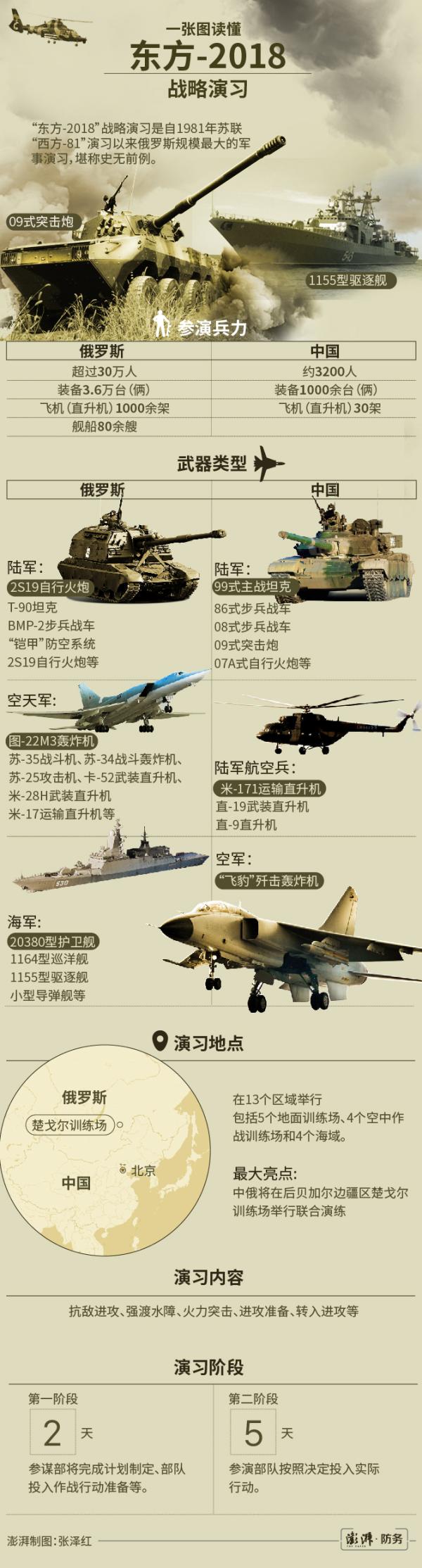
The main forces of our army participating in the "Oriental -2018" strategic exercise are a heavy synthetic battalion and a medium-sized synthetic battalion, which are jointly organized into the "Red Army" with the three group armies of the Eastern Russian Military Region to counter the "Blue Army" composed of the two group armies of the Central Russian Military Region. The integration degree of this exercise is far better than any previous Sino-Russian joint exercise, so it provides us with the best opportunity to observe and compare the similar equipment of the Chinese and Russian armies at close range.
Main battle tanks: each has its own characteristics, and the number of Russia is dominant.
The main battle tank model of our army participating in the "Oriental -2018" strategic exercise is Type 99, not the most advanced Type 99A in active service. The Russian main battle tanks were earlier T-72BV and later improved T-72B3. In our usual impression, the T-72 series are all "low-equipped" third-generation main battle tanks with overall performance lower than that of Type 99. Actually, it is not. In fact, from T-72M to T-72B/BV in the early 1980s to T-72B3/B3M which has been greatly improved now, although it still belongs to the same model family, its overall performance is not the same. In particular, Russia’s latest improved T-72B3M, after refitting with a 1130 HP turbocharged diesel engine and the same main gun and fire control system as the T-90, is very close to our army’s 99-type main battle tank in overall performance. Moreover, the T-72B3M can also use a 9M119M gun-launched missile with a range of 5000m and an armor-piercing power of 900mm.
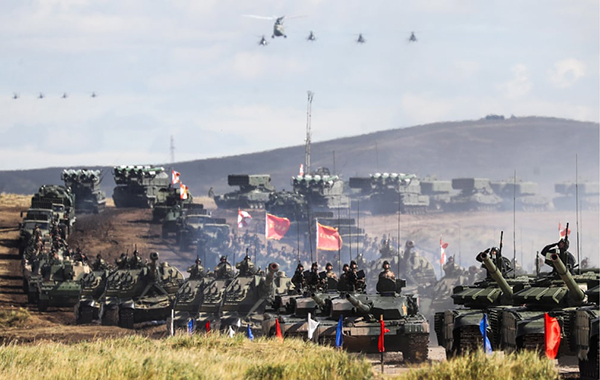
中俄主战坦克引领阅兵方阵。
另外,我们还需要注意到的是,目前俄罗斯陆军已经完成了主战坦克的“三代化”,即全部为T-72、T-80和T-90三大系列,并且正在向第四代主战坦克T-14过渡。之前从苏联时代遗留下来的T-55、T-64等老旧坦克都已经全部退役封存。相比之下,我国陆军现役还有为数不少的59式、88式等第一代和第二代主战坦克,要完全实现“三代化”还需时日。
而且,俄罗斯陆军目前还有大量封存储备的T-72、T-80和T-90主战坦克,总数超过上万辆。因此,可以看到,当俄军要扩充主战坦克装备数量时,并不需要大批量采购全新生产的坦克,只要从储备中挑选状态比较好的进行翻新和升级就可以。而我国陆军还处在采购全新第三代主战坦克代替老式第一代和第二代主战坦克的过程中,相对来说要付出更多的成本。
Infantry fighting vehicles: China has a complete range of wheeled fighting vehicles.
In terms of crawler-type combat vehicles, the Chinese Army mainly dispatched Type 86 infantry combat vehicles this time. The Russian army can be described as elite, including improved BMP-2, BMP-3 infantry fighting vehicles and BMD-3/4 paratroopers fighting vehicles. The reason why we didn’t send our most advanced 04A infantry fighting vehicle is that the participating troops haven’t changed their clothes. However, no matter from the type or general performance, the Russian army still has deeper strength in the development and use of tracked vehicles and chassis.
For example, Russian BMP-2 is still improving, and its combat performance is also advancing with the times by improving fire control performance and replacing a new generation of 9M133 "cornet" anti-tank missiles. BMD-4 is the most powerful paratrooper chariot in the world at present, which is equipped with the same fire system as BMP-3, and can almost be called an airborne tank. In addition, MT-LB, a seemingly old crawler-type universal chassis, is still in its prime and plays an irreplaceable role in the Russian army.
In terms of wheeled chariots, I’m afraid the Russian army will envy our army. At present, the main wheeled chariot of Russian army is BTR-82A, which appeared in the exercise, but it is only an improved model of the original BTR-80. Our army sent 08 type 8X8 wheeled infantry fighting vehicle and 11 type 105mm 8X8 assault vehicle, which are outstanding among domestic 8X8 wheeled vehicles, and their overall performance is beyond the reach of Russian BTR-82A. Especially the 11-type 105mm 8X8 assault vehicle, the Russian army has long been eager to equip this new type of equipment with high maneuverability and powerful firepower. However, limited by the design of Russian-made BTR-80 wheeled chassis, it can not be converted into a large-caliber assault vehicle at all, and the Russian army does not have such a suitable artillery as the 105 mm rifle. Therefore, during the period when Russia had the best relationship with European countries, the Russian army once wanted to purchase a batch of "Centauri" 105 mm wheeled assault guns from Italy, but it failed in the end. Nowadays, many Russian officers and men will feel a lot of emotion when they see our 11-type 105mm 8X8 assault vehicle.
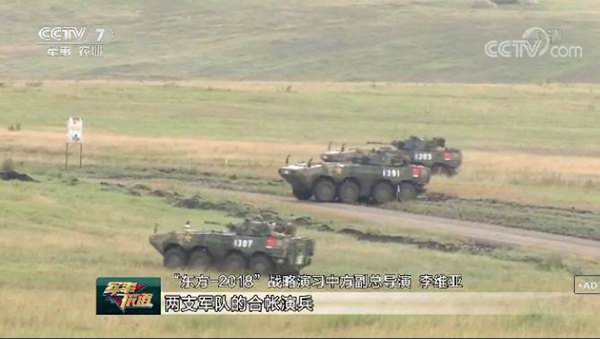
The overall performance of Type 08 8X8 wheeled infantry fighting vehicle is beyond the reach of Russian BTR-82A.
Self-propelled artillery: modular technology leads China.
In this exercise, our army dispatched 07-type 122mm tracked self-propelled howitzer and 09-type 122mm 8 X 8 self-propelled howitzer. Two different chassis and the same fire system show China’s achievements and strength in the development of 122 mm howitzers. However, on the other hand, the Russian army participated in the 2S1 122mm tracked self-propelled howitzer which was equipped in 1972. At present, 2S1 has more than 500 pieces of equipment in the Russian army.
These two kinds of 122mm self-propelled howitzers of our army, like the Russian 2S1, have their fire systems derived from the Soviet D30 122mm towed howitzers. However, since the D30 and 2S1 were equipped with troops, the Russian army has basically given up the development of 122 mm artillery, but replaced it with 120 mm howitzers from the perspective of simplifying logistics support and artillery equipment system. In this way, in the future, the new generation of large-caliber barrel suppression artillery of the Russian army will mainly be 152 mm howitzers and 120 mm forced howitzers. However, this dressing plan obviously did not go smoothly.
In contrast, our army has simultaneously promoted the development of 155 mm howitzers, 122 mm howitzers and 120 mm forced howitzers in large-caliber barrel suppression artillery. The 122 mm howitzer has developed three generations of crawler type, vehicle-mounted type, wheeled armored type and amphibious type. The same is true of the development of 120 mm howitzer, and the derivative models of its different chassis are not less than those of Russia. In this way, through the coordinated use of three different caliber and types of barrel suppression artillery, our artillery units can be more handy in attacking enemy targets.
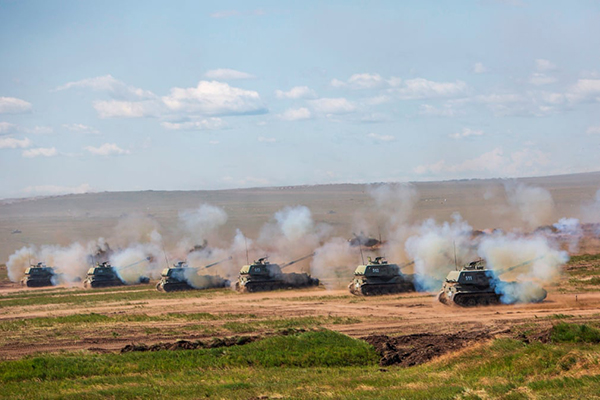
At present, there are more than 500 pieces of 2S1 self-propelled howitzers in the Russian army. The picture shows the 2S1 self-propelled howitzers being fired.
In the grand military parade of the "Oriental -2018" strategic exercise, we also saw the 2S25 Octopus -SD 125mm tracked self-propelled anti-tank gun. Nowadays, with the retirement of Type 89 120mm tracked self-propelled anti-tank gun, there is no chariot similar to 2S25 in the equipment sequence of our army.
2S25 Octopus -SD is equipped with a lightweight 2A75 125mm smoothbore gun, but it can fire all the ammunition of the main gun of the same caliber main battle tank, and its damage power is not compromised. On the contrary, because the gun adopts the chassis of BMD-3 paratroopers, it also has the same high maneuverability and airdrop capability. Therefore, 2S25 Octopus -SD has become the most powerful direct support firepower for its airborne troops after being equipped with Russian troops. At present, our army has not equipped airborne troops with similar large-caliber tracked self-propelled anti-tank guns, and the main constraint is whether the lightweight 125mm smoothbore gun can be successfully developed. Europe, America and Russia have achieved this technological breakthrough, and China still needs to catch up.
In terms of rockets, our army sent 11-type 122mm modular self-propelled rockets, while the Russian army participated in the old BM-21 Hail 122mm and BM-27 Hurricane 220mm wheeled rockets. The 11-type 122 mm modular self-propelled rocket launcher is the latest main battle suppression weapon of our army, which is divided into two types: wheeled and crawler, replacing the previous 81-type and 89-type self-propelled rocket launchers respectively. The gun adopts two modular packaging integrated launch boxes, each equipped with 20 directors, so the number of spare bombs is 40 as BM-21 Hail. However, the loading speed of our army’s 11-type 122 mm modular self-propelled rocket launcher is much faster than BM-21 Hail, and the fire control system is more advanced. More importantly, the maximum range of the new 122 mm rocket launched by the Type 11 self-propelled rocket launcher has exceeded 40 kilometers, which is twice that of the same type of ammunition of the Russian army. You know, our army’s 122mm rocket launcher technology originally originated from BM-21 "Hail", but now it has already left the similar equipment of Soviet Russia far behind, which can be described as shine on you is better than Blue.
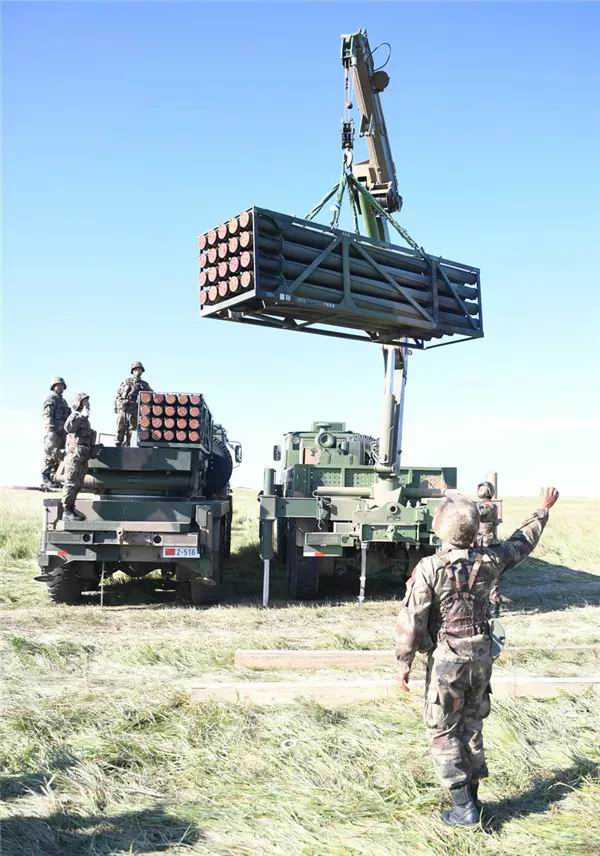
The loading speed of 11-type 122 mm modular self-propelled rocket launcher is much faster than BM-21 "Hail".
Field air defense system: Russia realizes full self-reliance and integration
As early as the Cold War, the Soviet Army attached great importance to the field air defense capability, so on the one hand, it realized all the self-integration and integration of the air defense system, on the other hand, it quickly built a field air defense system with self-defense missile system as the main part and self-defense antiaircraft gun system as the supplement. After the disintegration of the Soviet Union, the Russian Army also basically inherited a complete set of field air defense systems, from the earlier ZSU-23-4 23mm self-propelled antiaircraft gun to the latest self-propelled air defense missile systems such as Doyle -M2, Armor -S1 and Beech, with nearly 10 models. Coupled with the S-300V long-range air defense missile system, it can be said that the Russian Army has the most powerful field air defense system in the army of various countries.
In contrast, the integrated high-mobility field air defense missile system equipped by the Chinese Army only has Doyle -M1 purchased from Russia and domestic model Hongqi -17. Other air defense missile systems, such as Hongqi -6, Hongqi -7 and Hongqi -16, need to be deployed on multiple platforms of the whole system before they can carry out operations, and cannot be protected with marching troops. The field air defense missile systems such as "Doyle" and "Tunguska" can completely launch missiles and intercept incoming targets while moving, and become an umbrella for armored forces to move. Therefore, in this exercise, the air defense of our army’s participating troops mainly relies on the Russian field air defense system. In this regard, China’s army field air defense system needs to be further improved.
Helicopters: each has its own emphasis, and Russian heavy-duty military forces are dominant.
Helicopter is also a very important item in the army equipment system. In this exercise, the Chinese Army dispatched Zhi -19 armed reconnaissance helicopter and Zhi -9 medium-sized general-purpose helicopter. These two types of military helicopters are exactly what the Russian army and aviation forces do not have. As early as 2005, Russian Kazan Helicopter Company exhibited an armed reconnaissance helicopter named "Anseth" -2RT, but it failed to arouse the interest of Russian troops. The card -62 similar to Zhi -9 is still in the test flight verification, and it will take some time to put it into use. Of course, on the other hand, the Mi -35 heavy armed transport helicopter and the Ka -52 heavy attack helicopter of the Russian Army Air Force are also types of equipment that our Army Air Force does not have. Therefore, the army and aviation units of the two armies can complement each other in equipment and better accomplish their combat missions.
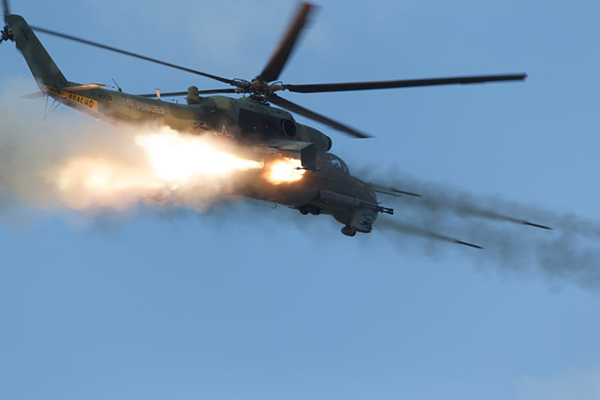
Chinese and Russian armed helicopters fired rockets during the exercise.
Enlightenment and reference
Generally speaking, the development path of China’s army equipment system is more similar to that of European and American countries, and it has absorbed many advanced ideas and concepts of the latter, including a large number of services of 8X8 wheeled armored combat vehicles and Warrior 4X4 high-mobility wheeled chassis. Moreover, China has made great efforts in the informationization, digitalization and networking of the army’s main battle equipment, all of which are aimed at catching up with the armies of European and American countries. In addition, on the basis of drawing lessons from foreign advanced experience, China’s army has also embarked on its own unique development path in terms of organizational reform, division reform, and highly integrated troops.
In contrast, the Russian army has taken many detours in both the establishment system and the equipment system. Including the repetition of the division-brigade preparation, and the new generation of main battle equipment such as T-14, which is unable to equip in large quantities after successful research and development, can only go back and continue to improve old equipment. Fortunately, since the end of the Cold War, the Russian army has accumulated rich practical experience and learned many bloody lessons through many local wars. Reflected in the development of equipment, we can see that the Russian army has an unusual enthusiasm for research and development of unmanned combat platforms and vehicle-mounted remote-controlled weapon stations. Therefore, although the development of Russian military equipment is tortuous, it is always exploring its own path. Promoting equipment development with operational needs will be the main driving force of Russian military’s future equipment system.
"Talking about Military Affairs" is a personal column written by Huang Guozhi, a senior editor of a well-known military magazine, for the defense of the surging tide. With an objective and rigorous attitude, supplemented by lively and refined language, it tries to "break the defense fog" and provide readers with a better understanding of the gap between China and foreign countries in equipment technology. )