[Those things in China] The number of "smiling angels" finless porpoises is becoming more and more stable. Hong Kong media: The ecological protection measures of the Yangtze River have achieved good r
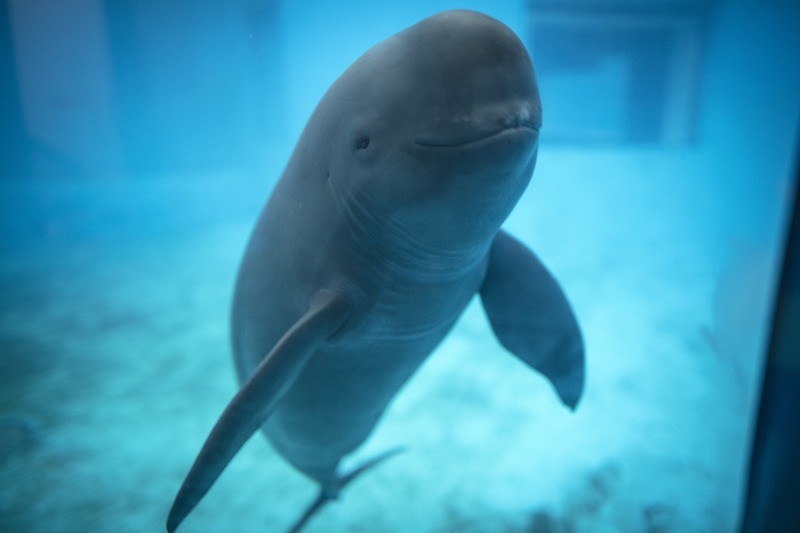
There are six Yangtze finless porpoises living in Wuhan Baiji Dolphin Museum, Institute of Aquatic Sciences, Chinese Academy of Sciences. At present, researchers mainly protect the Yangtze finless porpoise by ex situ conservation and artificial breeding. Xinhua News Agency reporter Xiao Yijiu photo
China Daily Online, December 26th The Yangtze finless porpoise is an ancient aquatic mammal, which has lived on the earth for 25 million years and is called the "living fossil" of the Yangtze River ecology. As the "indigenous people" of the Yangtze River, the finless porpoise is a mammal at the top of the Yangtze River food chain, and its fate directly reflects the health status of the Yangtze River. The latest research shows that thanks to the government’s remediation of water pollution and overfishing, the development of artificial breeding project of Yangtze finless porpoise and the increasing public awareness of protection, the decline trend of Yangtze finless porpoise population has been obviously curbed, and a series of protection measures of Yangtze River ecosystem have achieved good results.
According to the website of South China Morning Post reported on December 20th, the number of finless porpoises has been decreasing due to the increasing human activities such as environmental pollution, overfishing, hydropower station construction and shipping noise. But environmentalists say that they now see the dawn of hope to save the finless porpoise.
According to data released by the government last year, there are only about 1012 Yangtze finless porpoises, which is less than 60% of the giant pandas. However, the decline rate of finless porpoise population has obviously slowed down since 2012, which indicates that relevant protection measures may have achieved results.
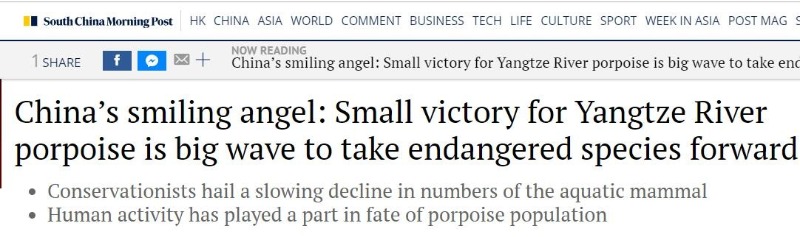
Researchers say that moving the finless porpoise to an ex situ conservation area far away from busy shipping means that the number of finless porpoises will increase.
In the early 1990s, about 30 to 40 finless porpoises moved into Swan Island Nature Reserve on the Yangtze River in Hubei Province, which was located in an oxbow lake formed by the Yangtze River, and now there are about 80 finless porpoises there.
Wang Ding, 60, is an expert in Yangtze finless porpoise research in China Academy of Sciences. He said, "We found that finless porpoises can not only survive in Swan Island, but also successfully reproduce naturally, which is very exciting."
Researchers believe that this is due to the government’s rectification of water pollution and overfishing, the development of artificial breeding projects for Yangtze finless porpoises, and the increasing public awareness of protection.
Zhang Xinqiao, head of the finless porpoise project of the World Wide Fund for Nature (WWF), said, "Public opinion supervision has played an important role."
The baiji, also known as the Yangtze finless porpoise, is another aquatic mammal in the Yangtze River. In 2006, scientists announced the functional extinction of the baiji dolphin. The government does not want the finless porpoise to repeat the mistakes of the baiji.
Yangtze finless porpoise is one of the few freshwater subspecies of finless porpoise in the world, and it is a barometer of Yangtze River ecology.
The finless porpoise can also be seen in China’s ancient poems. People believe that when the finless porpoise appears on the river, it means that heavy rain is coming. The Yangtze finless porpoise has a chubby body and a round head, so some people call it "Jiang pig". Adult finless porpoises can reach 2 meters in length. Finless porpoises are often killed, and finless porpoises’ livers have also been used as medicinal materials.
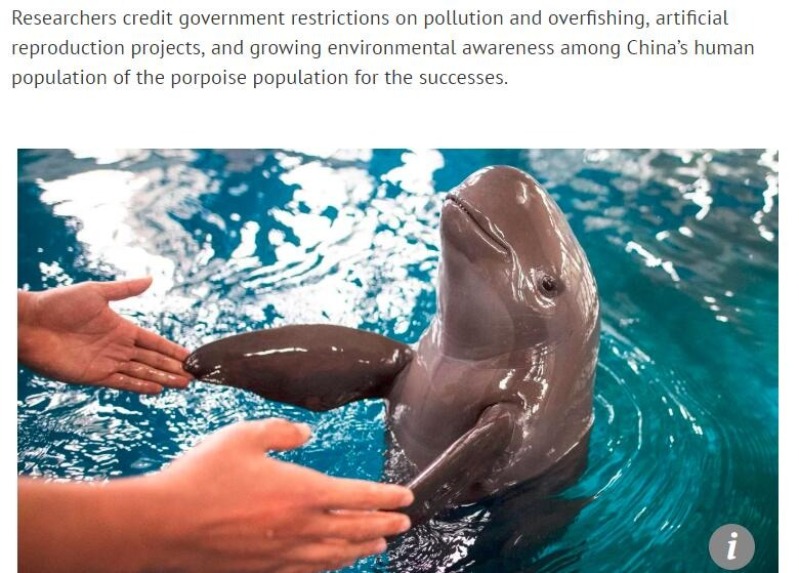
Since 2012, the declining trend of the Yangtze finless porpoise population has been significantly curbed. Image source: South China Morning Post report screenshot
In January, 2016, the national leaders of China issued instructions to do a good job in the ecological protection of the Yangtze River. Relevant measures include promoting coordinated development, implementing stricter fishery management system and carrying out other protection projects.
At the end of 2016, the action plan to save the Yangtze finless porpoise was officially launched, including strengthening ex situ conservation, establishing more protected areas and promoting research on artificial breeding technology.
Tianezhou Nature Reserve was established in 1992, which is said to be the first and only successful case of whale ex situ conservation in the world. The finless porpoise not only survived after migration, but also bred the next generation.
The government encourages fishermen near ex-situ conservation areas to change careers. Wang Hesong, 46, is now a ranger in the reserve.
Wang Hesong said, "Look, mother finless porpoise and a baby finless porpoise." Seeing two arched backs on the water, the patrol stopped the boat. Two finless porpoises soon returned to the water. "The finless porpoise will stick its head out to breathe for a few seconds … … We come to patrol every day and see them every day. "
Oxbow Lake provides a shelter for finless porpoises, but finless porpoises living in this water area are also under great pressure.
Zhang Xinqiao said, "They have nowhere to hide here. As long as threats like the deterioration of natural habitat conditions exist, the number of finless porpoises may decrease sharply again."
The Institute of Hydrobiology, Chinese Academy of Sciences, located in Wuhan, raised six Yangtze finless porpoises for scientific research, artificial breeding and public visit.
Through the glass window, you can see two finless porpoises spinning gracefully in the breeding pond, reaching out of the water playfully and looking at the tourists. Liu Hanhui, a volunteer, said, "They are greeting us. I think finless porpoises are human. "
According to WWF, the intelligence of an adult Yangtze finless porpoise is equivalent to that of a child aged three to five. Before feeding the finless porpoises, they have to be coaxed to open their mouths. They will smile and extend their flippers to shake hands with people.
However, it is difficult for Yangtze finless porpoises to breed in artificial breeding environment.
In June this year, a small finless porpoise was successfully born in Baiji Dolphin Museum, Institute of Aquatic Sciences, Chinese Academy of Sciences. This is only the second small finless porpoise that has lived to be 100 days since the Baiji Dolphin Museum was built in 1980. However, wild finless porpoise cubs often do not live to adulthood because of human damage to the environment.
Liu Hanhui is a student majoring in aquaculture in a nearby university. He and the other 40 volunteers helped the staff feed the finless porpoise on weekends and holidays, and participated in publicity activities to protect the finless porpoise.
In recent years, in order to raise public awareness of protection, with the support of many enterprises and non-governmental organizations, the number of projects and activities related to the protection of finless porpoises in this area has surged.